
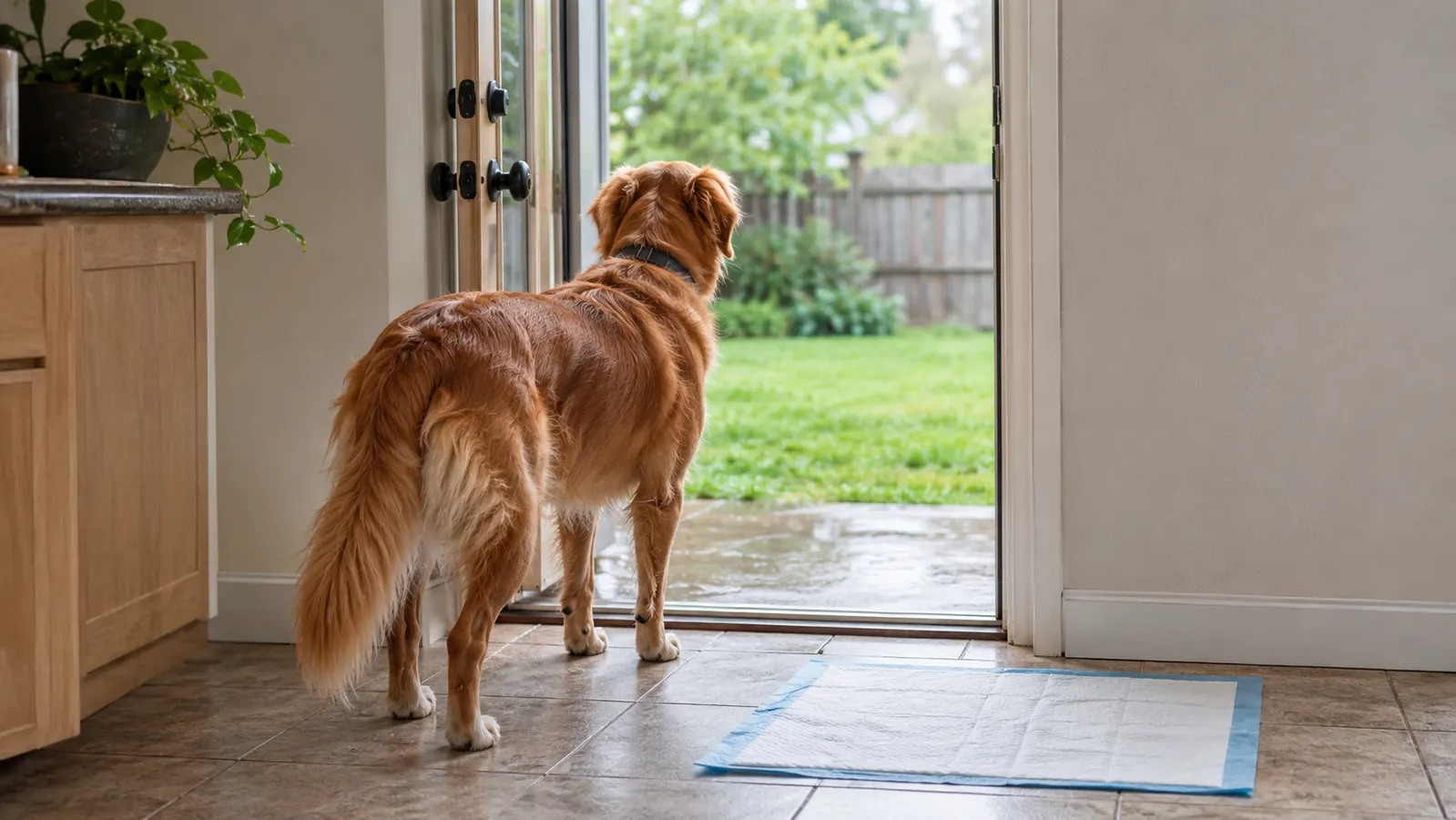
Biscuit came home from the county shelter at two years old with a lot to learn and one habit already set in concrete, so to speak. He had spent most of his life on a concrete run, and as far as he was concerned a floor was a floor. Our kitchen tile looked like more of the same to him. We brought him home on a Friday. By Sunday afternoon I had mopped that floor four times and was starting to wonder whether a 61-year-old retired mail carrier had any business house training a 65-pound Lab mix. That is when my wife June set a package of Glad for Pets Puppy Pads on the counter and told me to stop making the job harder than it needed to be.
I have been using those pads for months now, not as a replacement for going outside but as a backup for the days when outside is not realistic. Ice storms in central Missouri. A thunderstorm that turns Biscuit into a 65-pound shadow glued to my leg. The two weeks after his dental work when the vet wanted him quiet. What follows is a plain account of how the 100-count box of Glad for Pets pads held up over that stretch, what the six layers actually do, and the parts I do not care for. If you are house training a puppy or settling in a rescue dog, you want the tradeoffs, not a sales pitch.
The Quick Verdict
Absorbent, tough on odor, and large enough for a big dog. The folded edges are the difference between a quick pickup and a scrub bucket. The 23-inch square is tight for a dog that circles before he goes.
Amazon Check Today's Price →The box that ended the four-mop weekend
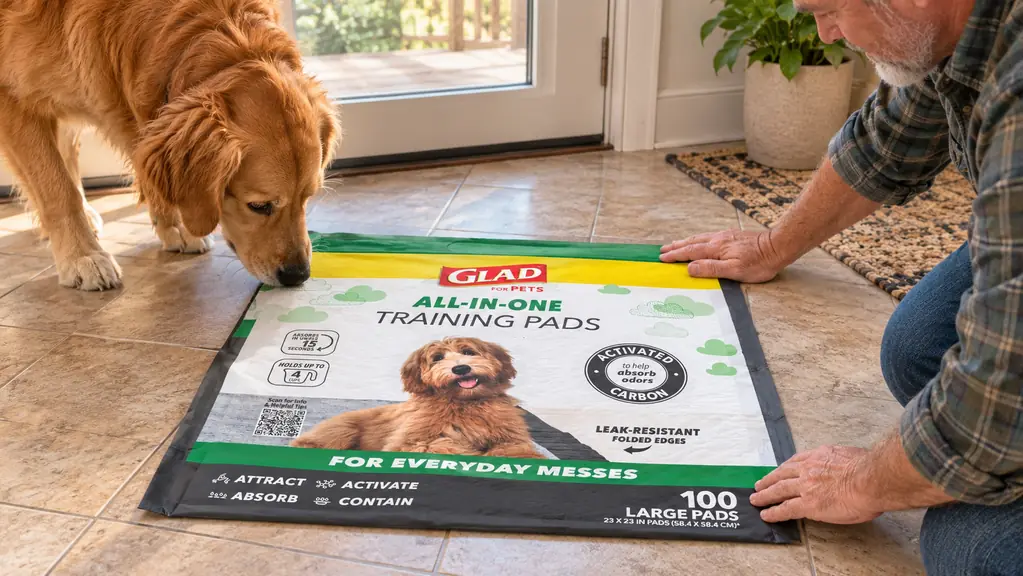
100 pads, 23 by 23 inches, six layers with an activated carbon sheet in the middle and a polymer core that turns liquid to gel. This is the count and the size I keep in the laundry room.
Amazon Check Today's Price on Amazon →How I've Used It
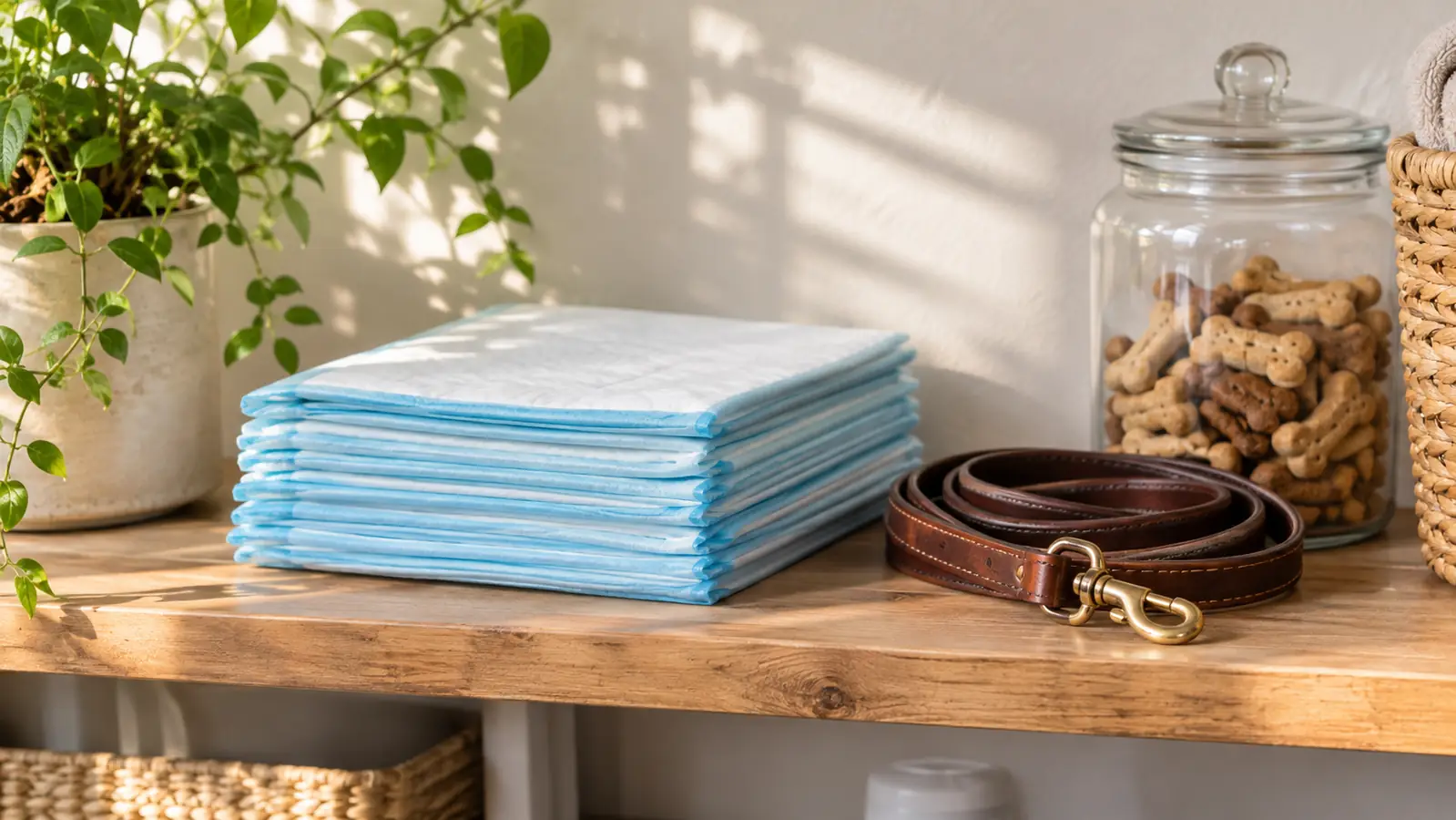
The way I use them is simple. I keep the box in the laundry room and pull three or four at a time. One goes by the back door, because that is where Biscuit asks to go out and where he sometimes does not make it in time. One goes flat in the bottom of his crate for the nights he gets restless. One goes in the back of the truck on Saturday trips to the park, since a 40-minute ride is a long stretch for a dog with a questionable bladder. And one rides folded in quarters in my jacket pocket when we travel. That is the whole system. No schedule printed on the wall, no apps, no gadgets.
The pads are not the training. The training is the trips outside, the same door every time, the same patch of grass, and a piece of freeze-dried liver every single time he goes. What a pad does is buy you a margin of error while the dog learns the routine. For the first three weeks I took Biscuit out every two hours on the dot, and I still set a pad by the door as insurance. Twice a day, on average, he would start circling before I had my shoes on. Sometimes I won that race. Sometimes the pad won. Both outcomes beat a mop and a sorry-looking dog slinking off to the bedroom.
Months in, we are down to a pad by the door for overnight and bad weather, and one in the truck. I change the door pad every other day if it stayed dry, immediately if it did not. In heavy early use, a 100-count box lasted us right around seven weeks, which works out to about two pads a day. These days a box lasts closer to three months. I mention that because it is the most useful thing I can tell you about a 100-count box: the count is the whole value, and how far it stretches depends entirely on how honest you are about taking the dog out.
What the Six Layers Actually Do
The listing says six layers, and I went looking, because I have bought pads before that were two layers with a marketing department. From the top down you get a quilted top sheet, then carbon tissue, then the absorbent polymer, then a cushion lining, then a PE film backing, with the edges turned over and sealed. The polymer is the working part. It takes the liquid and turns it into a gel, so when you pick the pad up, nothing sloshes. The listing puts capacity at up to four cups per pad. With a 65-pound dog I believe the number, because his morning output is not four cups, but it is enough that thinner pads have failed on me before.
The folded edge is the detail I did not expect to care about. Cheaper pads have a flat edge, and a flat edge wicks. Liquid runs to the border, sits in the seam, and finds the floor. These have that turned-over border, and in months of use I have had exactly one leak through an edge, on a pad that had already taken two full loads because I was distracted by the phone. The gel set is the other half of it. A pad that has gelled stays put when you fold it in on itself, corner to corner, which is how I pick them up and drop them in the wastebasket.
Size matters more than I expected. Each pad measures 23 inches by 23 inches, which sounds generous until you watch a Lab mix circle three times and land half a foot off center. For a puppy or a small dog, one pad is plenty. For Biscuit in those early weeks, I laid two side by side and overlapped the edges an inch. That is not a knock on the pad. A big dog simply covers more ground, and a 23-inch square has to be pointed at the right spot to do its job.
How They Held Up Over Months
I have been running these through a wet spring and a hot summer, and the wear pattern has been consistent. The quilted top sheet does not shred under a dog's nails the way the thin paper pads do. The quilting holds its shape after a night of pacing on it. Out of the box, two pads separated at a corner when I unfolded them, which is two out of a hundred and about what I expect from anything that ships in that quantity. Neither one leaked. Both went in the trash, and I did not think about them again.
My one real complaint is that nothing holds a pad down on its own. There is no adhesive on the back, and I have not found a way to make one stick to sealed concrete or kitchen tile. On carpet it stays where you put it. On tile, a dog that scratches at the pad before he uses it will push it a foot out of position, and then you are getting the mop out anyway. I solved it with a flat rubber mat under the pad by the door. That is less a defect than a fact of life about pads on hard floors, but you should hear it from me before you buy rather than after.
Storage is easy. The package measures 7.09 by 12.6 by 11.22 inches, so it fits on a laundry shelf or in the bottom of a closet without taking over the space. I stand the pads upright in the box and pull from the front. One caution: if the box sits in a humid garage, the top few pads will wrinkle and curl at the corners. Keep them inside the house and they stay flat.
The Carbon Layer and the Smell Question
The activated carbon is the reason I stopped buying the store brand. Carbon tissue sits under the top sheet, and it does what carbon does, which is bind odor instead of covering it with perfume. In practice, a used pad by the back door in July does not announce itself to the whole house the way the plain pads did. The kitchen stops smelling like a kennel. It is not sorcery. Leave a used pad on a warm floor for two days and you will smell it. Change it the way you should, and mostly you will not.
The listing also claims these stay fresh and dry twice as long as standard pads. I cannot run a lab test in Sedalia, but I can tell you what it looked like in my house. With the cheap pads, a pad used once was wet on the surface and had to come up right away or Biscuit would walk through it. With these, the surface reads dry within a minute or two, and I have left a lightly used pad down until the next morning without regret. Twice as long is a claim off a box. Dry to the touch in under two minutes is what I actually watched happen.
Where They Fall Short
The honest downside is volume. These are disposable. A dog that uses a pad twice a day means 60 pads a month going into the trash, and no amount of gel changes where they end up. That is why I use them where they solve a real problem, overnight by the door, in the crate, in the truck, and not as an excuse to skip a walk. If your plan is to let the dog use pads all day because it is convenient, you will go through a box a month and your dog will not learn the yard. That is a decision about training, not about the pad.
The other thing I would flag is chewing. If you have a puppy who explores with his mouth, a pad is a tempting sheet of crinkly material, and the gel inside is not something you want a dog eating. Biscuit was past that stage when he came to us. A neighbor's eight-week-old was not, and she ended up buying a pad holder with a grate over it. If your pup is a chewer, plan for that before the first box, not after.
And the circling problem deserves its own line. A large dog that paces before he goes will test the edges of a single pad. Two pads overlapped, or one pad with a washable mat underneath, is the setup that finally worked for us. Do not buy one box and expect one square to cover a 70-pound dog every single time. Buy the box, buy a mat, and set yourself up once.
What I Liked
- Six layers with an activated carbon sheet, which genuinely cuts odor in a warm kitchen
- 23 by 23 inches is big enough for a large dog when you overlap two pads
- The polymer turns liquid to gel, so nothing sloshes when you pick a pad up
- Leak-resistant folded edges held up over months with a single edge leak
- Quilted top sheet does not shred under a dog's nails
- A 100-count box stores easily on a laundry shelf
Where It Falls Short
- Nothing holds a pad down on tile or sealed concrete
- A large dog that circles needs two pads overlapped
- Disposable, so a heavy-use month means 60 pads in the trash
- Not for dogs that chew, the gel is not meant to be eaten
- Two pads out of the box separated at a corner when unfolded
Two pads side by side got us through a thunderstorm and two weeks of dental recovery without a single mop, and the carbon sheet kept the kitchen from smelling like a kennel.
Who This Is For
This is for the person house training a puppy in an apartment, or settling in a rescue dog that never learned, or managing an older dog whose bladder does not give much warning anymore. It is for the household that wants one backup spot by the door for storms, travel crates and the weeks after surgery. And it is for the owner of a larger dog who is tired of thin pads that tear, shift and leak at the seam. If that is you, the 100-count box of Glad for Pets pads is what I would put in the laundry room and leave there.
Who Should Skip It
Skip these if your dog shreds anything left on the floor, because a pad is not a chew toy and the filling is not harmless. Skip them if the plan is pads instead of going outside, because a dog trained only on pads never learns the yard, and that habit is harder to break later than it is to teach now. And skip the 100-count box if you only need a couple of pads a month for a small dog, since the cardboard will go soft long before you reach the bottom. Nothing here is complicated. It is a good pad used for the right job.
One box in the laundry room covers the storms, the crate and the truck
100 pads at 23 by 23 inches, six layers with a carbon sheet, up to four cups per pad and a polymer core that gels on contact. Buy it before the puppy comes home, not after the third mop.
Amazon Check Today's Price on Amazon →