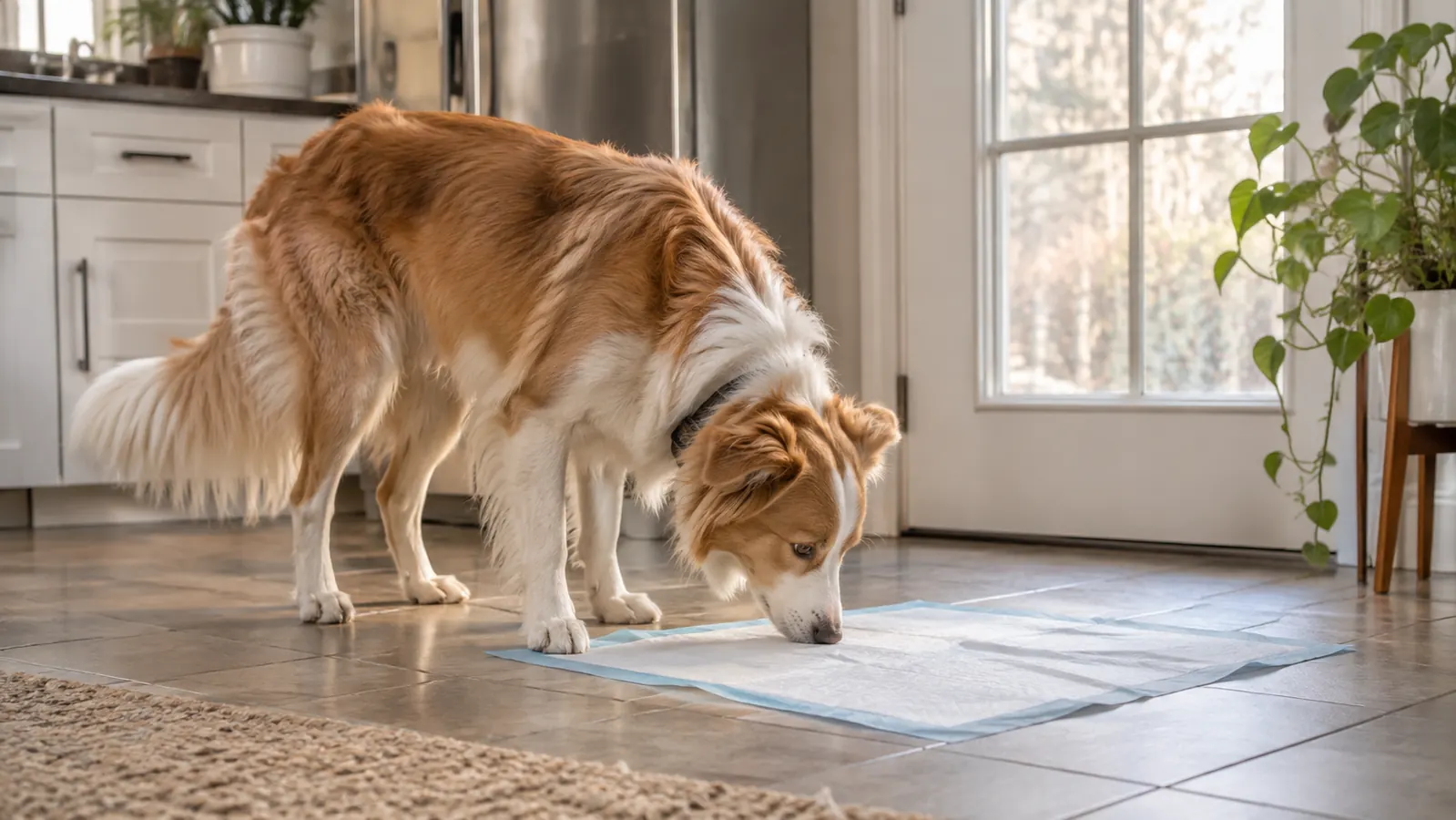
If you are raising a puppy or settling in a rescue dog, the question is not whether you will clean up accidents. It is where you will clean them up. I am Roy Kessling, 61, retired after 28 years on a walking mail route here in Sedalia, Missouri. My wife June and I adopted Biscuit, a 3-year-old Lab mix, from the county shelter when he was 2. He came to us at about 65 pounds with a lot of energy and no clear idea that the backyard was the bathroom. We used Glad for Pets Puppy Pads during his first weeks, and we also kept a real outside routine. That is the comparison I want to walk you through.
The short answer is that neither method wins outright. Glad for Pets Puppy Pads win the moments when your dog cannot get outside in time, especially overnight, in bad weather, or during an illness. Going outside only wins the long game, because it teaches the dog the surface you want him to use for the rest of his life. Most households do better with a bridge than with a permanent indoor bathroom. The table below is the honest scorecard I would give a neighbor.
| Glad for Pets Puppy Pads | Going Outside Only | |
|---|---|---|
| Overnight accidents | A fresh pad by the door gives the dog a legal place to go at 2 a.m. | The dog either holds it or the floor gets it |
| Rain, ice and heat | You stay inside and still have a target | Every trip happens in the weather |
| Very young puppy bladder | A 23 by 23 inch pad holds up to 4 cups and buys you time | A puppy may not make it to the yard in time |
| Long-term house training | Useful as a bridge, risky if it becomes the permanent bathroom | The dog learns the real bathroom surface from day one |
| Ongoing supplies | You buy packs of 100 pads again and again | No supplies to buy |
| Trash and floor cleaning | Used pads go in the trash | No pad trash, but more floor cleaning during training |
| Sick dog or recovery | A pad keeps a dog with limited mobility close to home | Frequent trips outside may be hard on both of you |
| Apartment or no yard | A pad gives you an indoor target when stairs and elevators are the obstacle | Depends on a yard or a safe route outside |
| Travel | A pad makes a hotel room or a visit easier | Unfamiliar ground can stall a dog |
| Smell | Carbon tissue and gel help between changes, but used pads still go in the trash | Messes stay outside, though the yard can get ripe |
How I Compared Them With Biscuit
Biscuit was not a tiny puppy. He was a full-grown rescue with adult bladder capacity and a habit of pacing by the back door when he got nervous. That made him a useful test case. For the first two weeks, I put a pad by the door at night and took him out on a schedule during the day. I did not leave him alone with a pad for hours, because a bored dog will shred paper. I also did not rub his nose in anything. That is not training. It is just making a dog distrust you. I have taken one group obedience class with Biscuit at the local pet store, and I am not a trainer. I am a man with a dog, a leash and a stack of treats.
I kept a simple log on the back of an envelope. I wrote down the time of each outside trip, whether he went, and whether the pad by the door was wet in the morning. I noted the weather. I noted whether June had let him out before I got up. This was not a laboratory study. It was a retired mail carrier with a clipboard and a dog who did not care about my data. But the pattern was clear enough. Biscuit did better when the pad was a backup and the yard was the main event. After three weeks I had nineteen check marks next to outside trips and four wet pads, and three of those four were on nights when the temperature dropped below freezing and nobody wanted to open the door.
What Glad for Pets Puppy Pads Actually Do
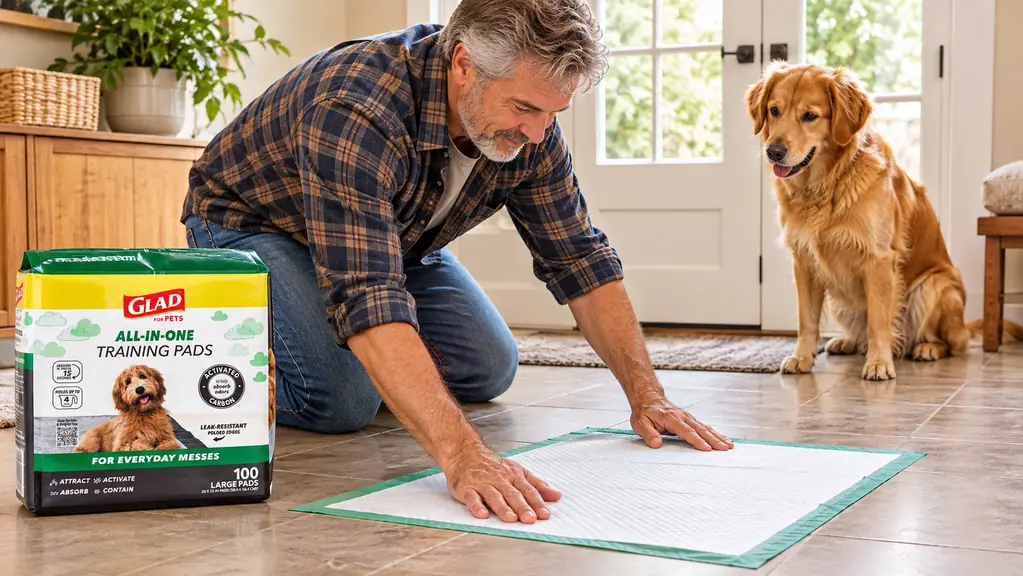
The product is simple. You get 100 pads in the pack. Each pad is 23 by 23 inches. The pad has six layers, including a quilted top sheet, carbon tissue, absorbent polymer, a cushion lining, and a PE film backing. The folded edges are leak resistant. The polymer turns liquid into gel, which makes a wet pad easier to pick up without a trail of drips across the kitchen. Glad for Pets says each pad holds up to 4 cups and stays fresh and dry 2X longer than standard pads. Those are the numbers I can verify from the package and the listing. The rest is what I saw in my own house. The listing calls the pad activated carbon, and the carbon tissue is one of the six layers. The whole pack weighs 3.3 pounds, which is light enough that June carries it in from the porch without asking me.
On a normal night, I put one pad by the back door before bed. If Biscuit had an accident, it landed on the pad instead of the tile. In the morning I folded the pad in on itself, put it in a trash bag, and wiped the floor anyway. The carbon tissue helped with the smell between changes, but a used pad is still a used pad. You do not want to leave one sitting for a week. The gel is the part that surprised me. A puddle that would have run under the door mat turned into something closer to jelly, and it stayed on the pad. The first week I made the mistake of laying the pad out flat with the edges curled up from the package. Biscuit stepped on the curl, the pad slid, and he went on the tile beside it. After that I smoothed each pad flat with both hands, corner to corner, and the sliding stopped.
The pad did not train my dog for me. It bought me a dry floor while I did the training.
Here is the limit. A pad is a tool, not a teacher. If you put a pad down and stop taking the dog outside, you are teaching him that the kitchen floor is the bathroom. That is a hard habit to undo. I used the pad as a backup for the first few weeks, then I moved it closer to the door, then I took it away during the day. At night I kept one down until Biscuit went two weeks without using it. Then I stopped. He has not needed one at night since, but I still keep a pack in the garage for emergencies.
Where Glad for Pets Puppy Pads Wins
Glad for Pets Puppy Pads win the situations where a dog cannot wait. A young puppy has a small bladder and very little warning. An older dog with arthritis may not be able to hustle to the door. A dog recovering from surgery may be on restricted movement. A rescue dog in a new house may be too anxious to relax in the yard. In those cases, a pad gives the dog a legal place to go and gives you a few more hours of sleep. That is not a small thing.
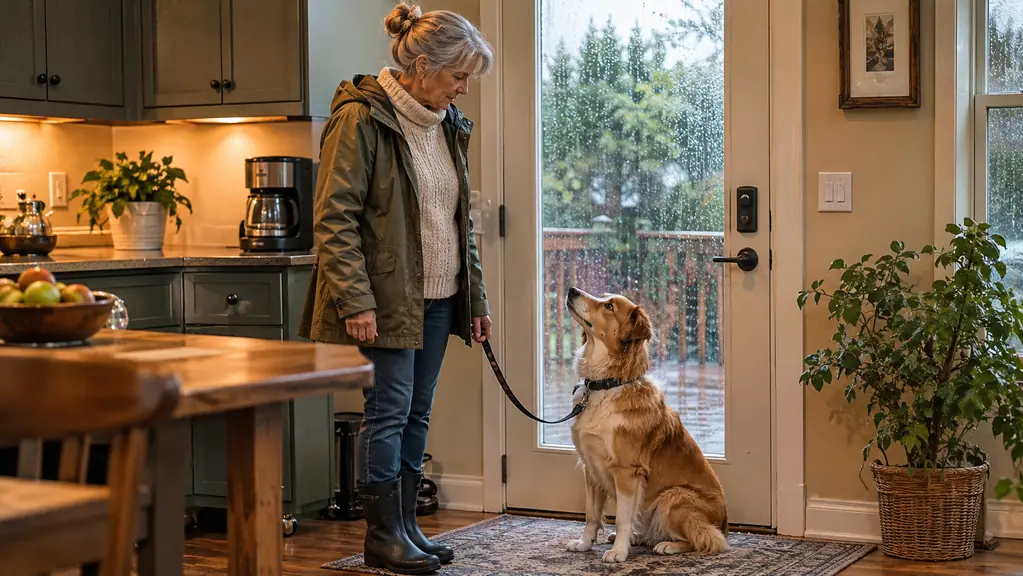
They also win the weather. Sedalia gets ice in January and heat in August. I have stood at the back door in a cold rain at 5:30 in the morning, watching Biscuit refuse to step off the porch. A pad by the door solves that. It also wins travel. When we travel, I do not know the yard, the neighbor dogs, or the schedule. A pad in a laundry room takes one variable out of the trip. For a 65-pound dog, the 23 by 23 inch pad is a target, not a whole room, so you still need to watch him. The one thing I would change is the size. Biscuit is a long dog, and he tends to start at the front edge. A second pad butted up against the first one gives him a wider landing zone, and I do that now whenever we travel.
One more thing. A pad is easier on the person doing the middle-of-the-night trip. I am 61. I can put on my boots and walk to the back door, but I would rather not do it three times before dawn. A pad by the door means one trip instead of three. That is not laziness. It is how you keep a routine going when you are tired. There was a stretch in February when I had a head cold and June was working early shifts. I put two pads down in the laundry room and slept through until six. Biscuit used one of them twice that week. The alternative was me standing in the yard in a bathrobe at three in the morning, and I can tell you which one of us was happier about the arrangement.
Where Going Outside Only Wins
Going outside only wins the long game, and I will not pretend otherwise. A dog who learns to eliminate on grass, gravel, or a curb has learned the surface you actually want him to use. There is no pad to buy, no bag of used pads in the trash, and no risk that the dog decides the hallway rug is close enough. If your dog is healthy, your yard is fenced, and someone is home every few hours, outside only is the cleaner long-term answer. It is also the simpler one. You put on your shoes and you go.
Outside only also avoids the dependency problem. I have seen dogs who will only go on a pad, even when they are perfectly capable of going outside. That is not the pad's fault. It is what happens when the pad becomes the routine and the yard becomes the occasional trip. If you choose outside only, you have to be consistent. You have to go out after every meal, after every nap, after every play session, and first thing in the morning. You have to stand there like a patient man in the rain and wait. That is the trade. When we started with Biscuit I went out every two hours for the first ten days, which meant twelve trips a day on a Saturday. It was tedious and it worked. By the second week he was going to the door on his own after breakfast, and that is a thing a pad will never teach a dog.
And there is a real cleanliness argument. A used pad goes in your kitchen trash, then into a bag, then into a can. That is a small chore every day. An outside-only dog leaves the mess in the yard, where you can pick it up with a bag and move on. If you have a sensitive nose or a small house, outside only has an advantage that the pad cannot match. You are not storing the bathroom in your house. June made that point to me in week one, and she was right. She also pointed out that a 100-count pack takes up shelf space in the garage, and she has a point there too.
A Backup Bathroom for the Nights You Cannot Predict
Glad for Pets Puppy Pads give you 100 pads at 23 by 23 inches, with six layers and a polymer core that turns liquid into gel. They are rated 4.4 stars across more than 109,000 reviews. Use them as a bridge, not a permanent bathroom.
Amazon See the Pad on Amazon →Who Should Buy Which
Buy Glad for Pets Puppy Pads if you are bringing home a puppy under six months, if you have a rescue dog who is too nervous to go in the yard, if you live in an apartment and the elevator ride is the problem, if your dog is recovering from surgery, or if you need a backup for overnight and bad weather. They are also a sensible first purchase for a household where an older adult is doing the middle-of-the-night trips. A pad by the door is easier on the knees than a leash walk at 2 a.m.
Choose outside only if your dog is healthy, your yard is secure, and your schedule lets you get him out every few hours. Choose it especially if you have seen your dog start to prefer the pad to the grass. In that case, the pad has become the bathroom, and you need to retrain the routine. You can still keep a pack for emergencies, but the daily work should happen outside. That is the balance I landed on with Biscuit. Pad as backup. Yard as the real bathroom.
No method fixes every dog in a week. Biscuit still has an accident if we get off schedule or if the weather keeps us inside too long. The goal is progress, not a perfect record. Pick the method that fits your dog, your home and your knees, then be boring about it. Same door, same times, same treats, same patience. That is what worked for us.
Keep the Yard as the Real Bathroom, Keep the Pad for Emergencies
If you want a dry floor while you build the outside routine, Glad for Pets Puppy Pads are the backup I keep in the garage. Start with the outside trips. Let the pad catch the misses.
Amazon Check Availability on Amazon →