
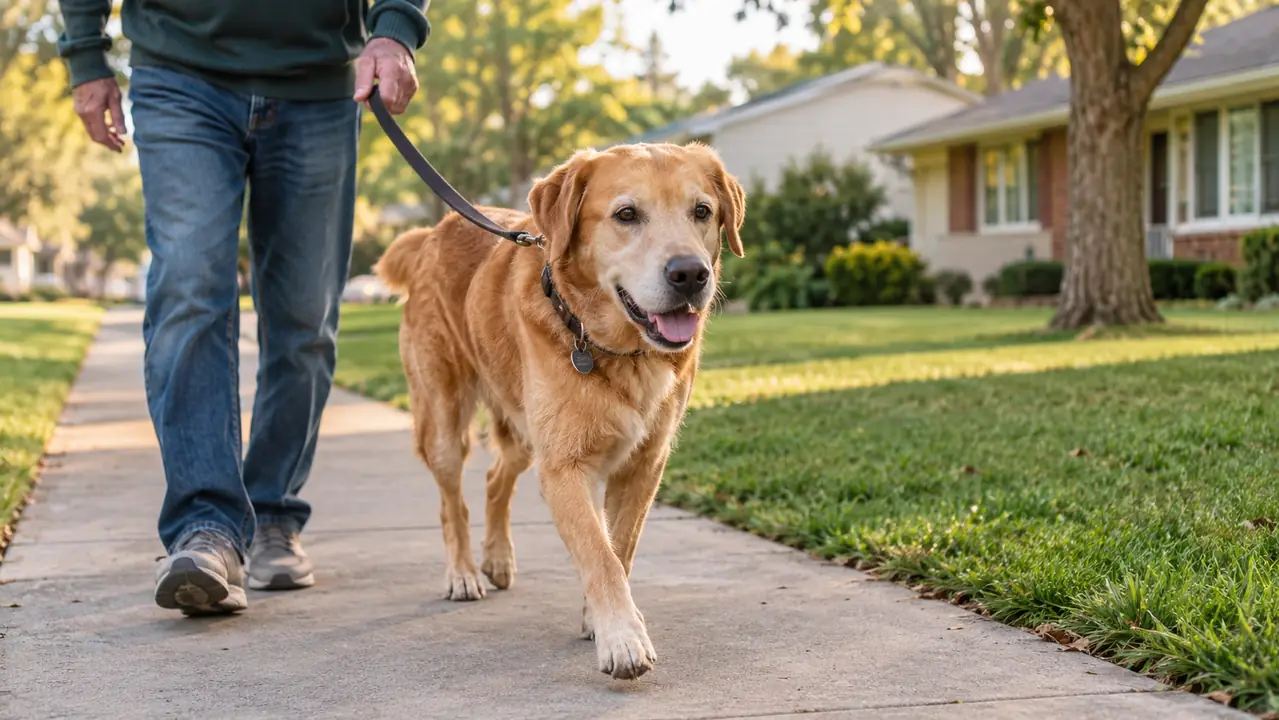
I spent 28 years walking a mail route here in Sedalia, Missouri, and I figured I had met every kind of dog there is. Then June and I adopted Biscuit from the county shelter and found out I had not met this one. He came home at two years old, about 65 pounds, full of ideas about which direction we ought to be going. I had ideas too. His were stronger, and my right shoulder paid for the disagreement for about four months. A neighbor off my old route mentioned the PetSafe Easy Walk. I ordered one that evening, half out of desperation and half because I liked how simple he made it sound.
Months later that harness lives on a hook by the back door, and I have a fair amount to say about it. Some of it is praise. Some of it is the part the listing photos skip right over. If you are in your sixties with a strong young rescue and a shoulder that files a complaint every morning, this was written with you in mind.
The Quick Verdict
It changed our walks in about two weeks and kept working for months. It will not train your dog for you and the fit takes real attention, but for the shoulder relief alone I would buy it again.
Amazon Check Today's Price →If your shoulder is losing the argument, this is where I would start
The PetSafe Easy Walk moves the leash to your dog's chest instead of his throat. That one change is most of why our walks got quieter.
Amazon Check Today's Price on Amazon →How I've Used It
Biscuit wears it on two walks a day, morning and evening, plus weekend trips to the city park about twenty minutes from the house. Our weekday routine has not changed much since March. I am up at a quarter after six, he hears me moving around in the kitchen and starts clicking his nails on the linoleum, and by six thirty we are out the front door for a mile loop around the block. I put the harness on him myself every single time, which matters because I am the one who has to learn the routine, not him. At first it took me a solid minute of fumbling and muttering while he stood there giving me a look. Now it is a five-second job and he stands still for it, mostly because a harness means a walk and he is nobody's fool.
Before this I tried two other things and both failed for reasons worth passing along. The first was the flat collar we brought him home in. In his second week with us he spotted a cat across the street and hit the end of that leash hard enough that he coughed for a minute afterward, and I felt sick about it the rest of the day. The second was a back-clip harness from the farm store out on the highway. That one was worse in a sneaky way. It was comfortable for him, which meant he was perfectly content to lean all sixty-five pounds into it and tow me down the block like a sled. I have since learned that this is a well-known thing with back-clip harnesses, and I will come back to it in a minute.
I did not buy it expecting a different dog. I bought it so I could keep my footing and so he would stop gagging himself against a collar. Those two things happened. What did not happen, and what I want to be plain about, is any kind of instant cure. The first week he still lunged at a squirrel and still dragged me toward a kid on a bicycle. The harness made those moments survivable instead of scary, and survivable is where training starts.
We have done one group obedience class at the pet store down the road, and I work with him at home a few short sessions a day with a pocket full of treats. The harness is a tool inside that routine, not a substitute for it. Our walks are calmer than they were in March. Calmer is not the same as finished, and I would not tell you otherwise.
What the Martingale Loop Actually Does
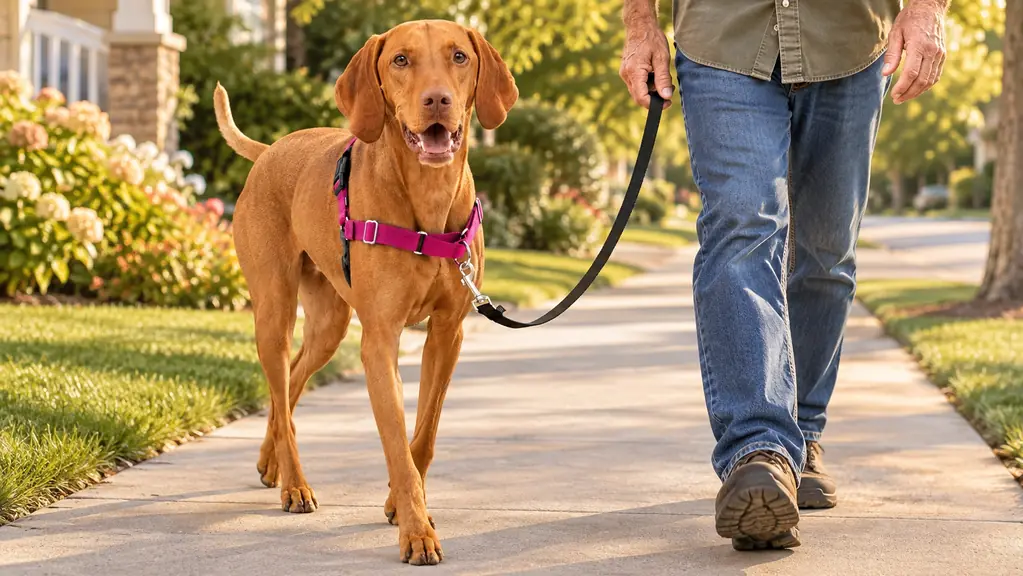
Here is the plain explanation, because it took me a while to get it. The Easy Walk uses a patented Martingale loop across the front of the dog's chest. When your dog pushes forward, that loop closes down gently and puts gradual pressure on the shoulders. When he eases off, the loop loosens again. Nothing tightens around the throat, and nothing stays tight once the pulling stops. That on-and-off pressure is the whole mechanism.
The second half of it is where the leash attaches. It goes at the chest, not up on the back. So when Biscuit surges ahead, the front of him gets nudged to the side and he ends up angled back toward me instead of leaning his whole weight into a strap. A dog cannot get much leverage when the pull point is at his chest. That is not opinion, that is just where the force lands.
The clearest demonstration came on a Tuesday in April. A delivery truck pulled up across the street and the driver popped the back door open, and Biscuit decided that was the most interesting event of his life. He went for it. With the collar I would have been dragged two steps and had to brace against the curb. With the chest attachment he got about a step and a half, the loop came up gentle across his shoulders, and he turned sideways so he was looking back at me instead of at the truck. I said his name, he looked, I gave him a treat, and we kept walking. Total disruption, maybe four seconds. That is the entire value of the thing in one paragraph, and no product listing can show it to you.
Compare that to a plain collar, where a determined dog leans in and tows you like a farm tractor, or a back-clip harness, where you have essentially given him a pulling yoke and a comfortable place to set his weight. I have walked behind plenty of both over the years. The chest attachment is the part that changed the arithmetic for us.
Fitting It Is Most of the Battle
I will say this as directly as I can: a badly fitted no-pull harness is worse than no harness at all. The PetSafe model has quick-snap shoulder straps, a buckle closure, and a belly strap in a different color from the rest of the harness so you can tell at a glance which side goes up. That last part sounds like a small thing. At six in the morning with a dog dancing around your knees, it is not a small thing.
Sizing runs off the chest measurement, not weight alone, and ours is the Medium. Measure around the widest part of the ribcage with a cloth tape and go by the chart rather than guessing. When it is on, you should be able to slide two fingers under each strap without a fight. The Martingale loop should sit flat across the front of the chest, roughly at the point of the shoulder, not down where it will rub behind the elbows. Check it before every walk for the first two weeks. I did, and I still check it once a week.
My first fitting was wrong, and I will tell you how so you can skip it. I measured him at 29 inches around the ribs, which put him at the top of the Medium range, and then I set the shoulder straps at the loose end because it looked comfortable to me. It was not. On the first long walk the belly strap slid around toward his armpit and the front loop dropped low enough that he stepped over it twice. He also backed clean out of the whole thing in the driveway when a neighbor's gate banged, which scared me more than it scared him. I snugged the shoulder straps in until I could get two fingers under each one and no more, raised the chest loop to sit at the point of his shoulder, and the sliding stopped. That adjustment cost me ten minutes and it was the difference between a harness that worked and one that was decoration.
The harness did more for my shoulder in two weeks than three months of me saying heel to a dog who had decided not to hear it.
How Biscuit Did Over the Months
Month one was mostly me learning. He pulled less the very first walk, which surprised me, and then he tested the thing constantly for a week to see if the rules still applied. They did. By the end of that month I could walk him one-handed past a barking dog behind a fence, which I had not managed since we brought him home.
I keep a note on the refrigerator, which June finds funny, but it is how I know what I know. April 3 was the first walk where he never hit the end of the leash once on the whole mile. That was not a fluke and it happened twice more that week. Then we had a bad stretch in the middle of May when the neighbors brought home a new puppy and Biscuit decided he needed to be in charge of the introductions. Two weeks of leaning and whining and me feeling like we had lost ground we had already paid for. What got us back was going shorter, five minutes at a time in the driveway before we ever left the yard, a reward every time the leash went slack. It came back. That is the honest shape of this, not a line going up, more like a set of stairs with a landing or two on the way down.
Months two and three were the good stretch. He stopped launching at the start of every walk. He still pulls when he first sees the park, and I do not expect that to ever fully leave a three-year-old Lab mix, but it is a lean now instead of a lunge. My shoulder stopped aching in the mornings somewhere in there, and that is the outcome I was actually shopping for.
On wear, the nylon has held up to daily use and one muddy spring. It is hand wash only, so once a month or so I rinse it in the sink with a little dish soap, hang it over the porch rail, and it is dry by the next walk. The stitching at the attachment point still looks sound after months of a strong dog hitting the end of it. There is a one-year manufacturer warranty, which I have not needed.
Where It Comes Up Short
It is not a trainer. If you put it on and never reward a loose leash or teach a turn, you will get a dog who pulls in a slightly different direction. The harness buys you control while you do the actual work, and that is all it buys you. I also had a patch where the front strap rubbed a little bald spot on Biscuit's chest during a wet week when the strap stayed damp. I loosened it a notch, kept it dry, and it cleared up in a few days. Watch for that if your dog is broad across the front.
Two more honest notes. Some dogs genuinely dislike pressure across the chest, and if yours freezes up or fights the harness every time, that is information, not stubbornness. And this is a walking tool, not something to leave on a dog in a yard or tie out on, which the PetSafe paperwork says plainly and I agree with. It is also hand wash only, so no tossing it in the machine with the towels.
What I Liked
- Chest attachment genuinely reduces pulling within the first few walks
- Martingale loop loosens the moment the dog stops pulling
- Quick-snap shoulder straps make it fast to put on once you learn the routine
- Belly strap in a different color means you can tell front from back at a glance
- Nylon has held up to months of daily walks and one wet spring
Where It Falls Short
- Fit has to be checked and rechecked or it rubs and slides
- Hand wash only, no machine washing
- Does not replace leash training or rewards, only supports them
- Some dogs dislike chest pressure and never settle into it
Who This Is For
This is for the person walking a strong, healthy dog who has never been taught leash manners, especially if you are older or have a shoulder, wrist or back that cannot absorb a sudden lunge. It is for the adopter with a two-year-old rescue who is sweet at home and a tow truck on the sidewalk. It is for the owner who is willing to measure, fit carefully, carry treats, and put in a few short sessions a day. If that is you, the PetSafe Easy Walk will very likely shorten the worst part of your learning curve.
Who Should Skip It
Skip it if you want the gear to do the training. Skip it if you are looking for something to leave on the dog all day in the yard, because this is not that. Skip it if your dog has a shoulder or neck injury you have not had a vet look at, or if he panics the moment something crosses his chest. And skip it if you will not measure him and check the fit for the first couple of weeks. A loose harness on a hard puller is how dogs learn they can back out of things, and that is a step backward.
Two weeks of walks is all it took to stop dreading the leash
Same harness, same dog, considerably less shoulder. Measure the chest, fit it snug, and keep the treats in your pocket.
Amazon Check Today's Price on Amazon →