
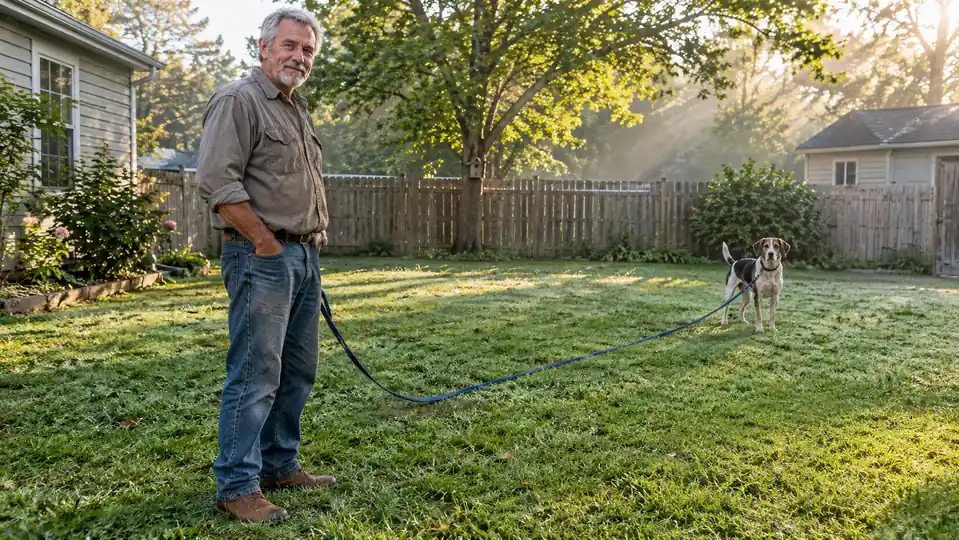
The first week I had the Hi Kiss long training lead in my hand, I wrapped it wrong, stepped on my own slack, and nearly went face first into the grass when Biscuit hit the end of it at a dead run. That was not the lead's fault. That was a 61 year old man learning a new piece of equipment in his own backyard. I say that up front because I want you to trust the rest of this. A long lead does not fix anything by itself. It is a length of nylon, and what you do with it is the whole story.
I am Roy Kessling. I carried mail on a walking route here in Sedalia, Missouri for 28 years, which means I have been barked at, chased and nipped by just about every kind of dog this town has to offer. That job made me hard to impress with a leash. What I care about is whether a thing holds up and whether it helps. My wife June and I adopted Biscuit from the county shelter when he was two. He is a Labrador mix, about 65 pounds now that he is three, and when he came home he pulled hard enough to make my shoulder ache by the end of the block, greeted guests by launching himself at their chest, and treated the word come as a suggestion from a stranger. I am not a trainer. I took one group obedience class with him at the local pet store and that is the whole of my formal education. The Hi Kiss long training lead is what I used at home, in the fenced backyard and on weekend trips to the city park, for months. Here is what I actually found.
The Quick Verdict
A plain 15 foot nylon lead that does one job well. It gave Biscuit room to make a choice and gave me a way to keep him safe while he made it. Not fancy, not self-correcting, and no substitute for showing up every day.
Amazon Check Today's Price →Biscuit Learned Come at 15 Feet Before He Learned It at 6
Distance is what turns recall from a tug of war into a choice your dog gets to make. That is where the learning happens. Check today's price and length on Amazon.
Amazon Check Today's Price on Amazon →How I've Used It
My routine was not complicated. Three short sessions a day, five to ten minutes each, usually after Biscuit had already burned off his first burst of energy in the yard. I kept a sandwich bag of cut up string cheese in my jacket pocket, because he will work for kibble but he will sprint for cheese. The first two weeks we never left the backyard. I clipped the Hi Kiss lead to his collar, let the whole 15 feet run out, and just walked around while he sniffed. That was it. No commands, no pressure. I wanted the lead to mean nothing before I asked it to mean something.
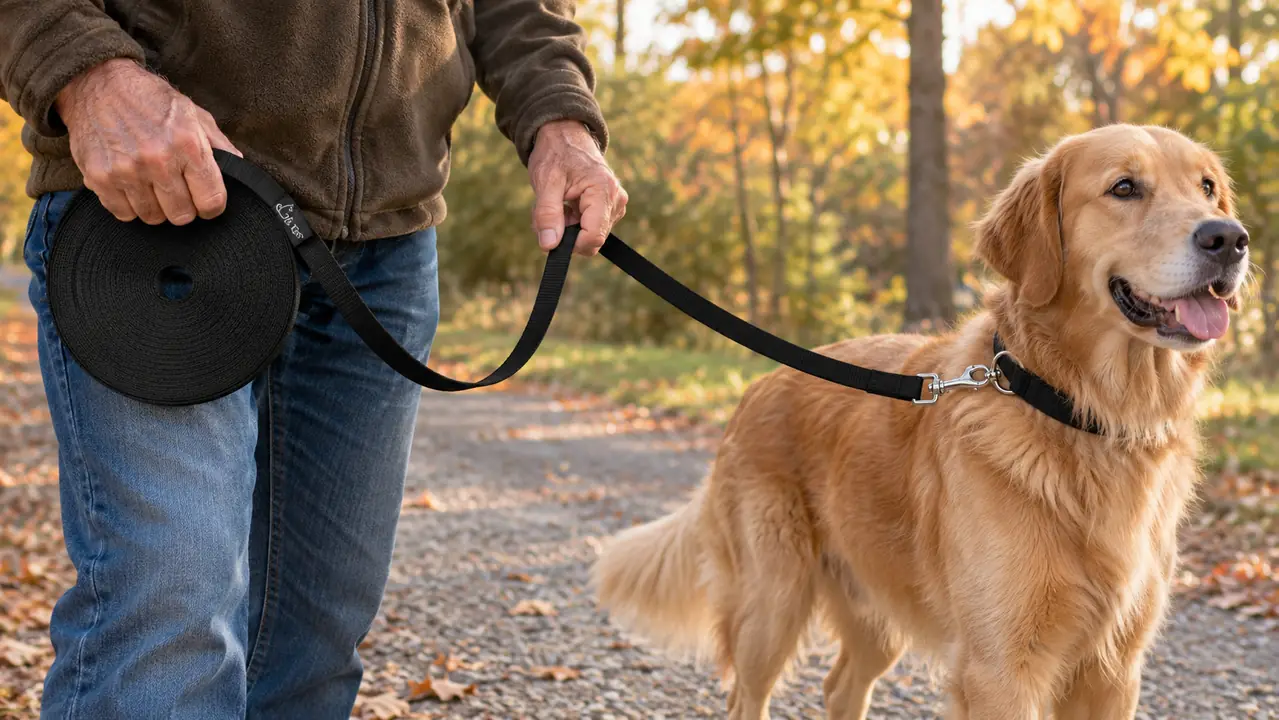
Holding 15 feet of lead takes a little practice. What worked for me was gathering the slack in loose loops in my left hand, never wrapping it around my wrist or fingers. I learned that from the group class and it is the one safety habit I would nag anybody about. If your dog bolts and the lead is wrapped around your hand, you are going to the ground with him. Loose loops let the line pay out and let you drop it if you have to. I also let the lead drag on the ground a good bit rather than keeping it tight, because a tight line pulls a dog forward and a slack line lets him decide.
Once the backyard was boring, we moved to the park on Saturday mornings when it was mostly empty. That is where the lead earned its keep. Biscuit could get 15 feet away and still be attached to me, which meant he could be wrong about a squirrel and still be safe. He could start toward another dog and I could step on the trailing line or call him back before he got there. There were setbacks. On the third Saturday in May he hit the end of it hard going after a squirrel and yelped, which I felt terrible about and which taught me to watch the slack better than I had been watching it. I had been watching the squirrel. That is the whole mistake, right there. And yes, I did get a nice rope burn across the back of my leg in June when I let a loop go while he was circling. That is a me problem, not a product problem, but you should know it is a real risk and it stung for two days.
What 15 Feet of Nylon Actually Changes
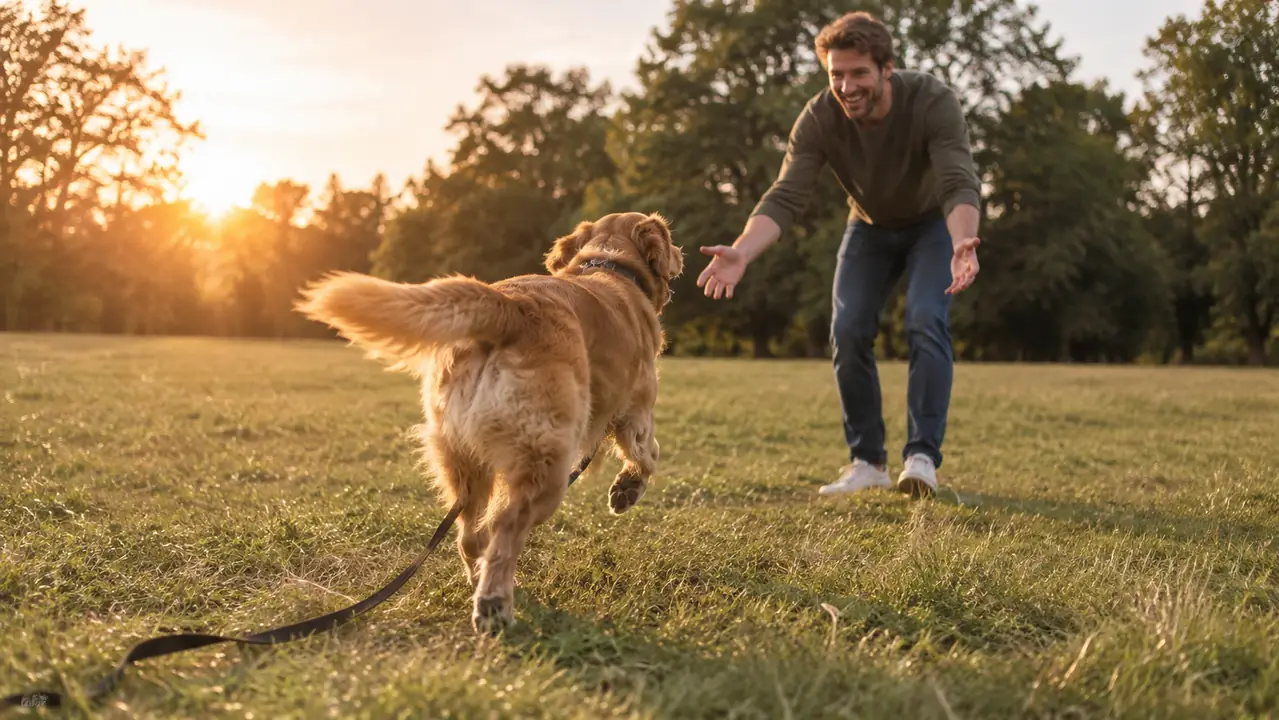
Here is the thing I did not understand until I tried it. On a 6 foot leash, every recall is a negotiation. The dog is already right next to you, so there is no reason for him to move toward you, and the whole exercise turns into you tugging and him leaning back. At 15 feet there is actual distance to cover, which means coming to me becomes a decision he makes and a trip he takes. I could see him thinking about it. That pause is where the training lives.
The other change is that I stopped correcting and started rewarding. With a short leash I was always managing, always pulling him out of things. With the long lead I could let him get most of the way into a mistake, call him, and pay him for turning around. That is the difference between a dog who complies because he is attached to you and a dog who chooses to come back. I kept a tally on the refrigerator door with a magnet, mostly because June got tired of me announcing it out loud after every session. Weeks three through six, Biscuit went from coming back maybe half the time to coming back most of the time in the yard, and by the end of that stretch I counted nine out of ten on a good evening. In the park it took longer. The first Saturday he turned away from a dropped french fry wrapper and came back to me instead was a bigger deal in this house than it sounds like. In the park it is still not perfect. I am not going to sit here and tell you he is fixed. He is better, and better is the point.
The last thing distance buys you is honesty. When your dog is 15 feet out and off sniffing something interesting, you find out whether your recall actually works or whether it only worked because he was already near you. That is uncomfortable and it is useful. I would rather learn that in a park with a lead on than learn it at a busy intersection.
The Boring Details That Decided It
The Hi Kiss lead is 3/4 inch wide and 15 feet long, made of nylon, and the listing says it will outlast cotton. I have not run a cotton lead side by side with it for a season, so I will only tell you what I saw, which is that the nylon did not stretch, did not go limp when it got wet, and did not fray at the stitching on either end. It weighs under two ounces, and that number matters more than it sounds like it would. A lead that is too heavy will not drag cleanly, and a lead that will not drag cleanly means you are holding tension all the time, which defeats the purpose.
There is a reason I ended up with a plain lead instead of a retractable. We had one of those for about three weeks. The problem was that it taught Biscuit that tension was normal, so he leaned into the line all the time, and I had no way to let him drag a slack line and make a decision on his own. A retractable keeps the line taut by design. What I needed was the exact opposite, a line that sat on the ground and did nothing until I asked for something. I gave the retractable to my neighbor Dale. He likes it fine for his old beagle. Different tool, different job.
The hardware is a swivel style bolt snap, and the swivel is the part I would pay for separately if I had to. Biscuit spins when he is excited and a fixed snap turns your line into a braid in about nine seconds. The snap closure opens and closes cleanly with one thumb, which matters when you have a 65 pound dog leaning into the end of the line and only one hand free. It is listed for medium breed sizes and that seems right to me. If you have a dog north of 90 pounds who lunges hard, I would want something beefier, and I would say that even though I like this lead.
Months Later: What Held Up and What Didn't
We are into the sixth month with this lead and it still looks like a lead. There is a gray film of dirt worked into the weave that I have not bothered to scrub out, and one small spot near the snap where the edge has softened up, but nothing has broken, nothing has come unstitched, and the bolt snap still snaps with authority. It went through a wet Missouri spring and a hot July, got dragged across grass, gravel, mud and one memorable puddle that Biscuit treated like a swimming pool, and it has not stretched a quarter inch. I rinse it off, hang it on the hook by the back door, and it is ready the next morning.
What did not hold up so well was my hand. There is nothing between you and the nylon, so on a long session I end up with a groove across my palm. I started wearing a work glove on my left hand and the problem went away. The other annoyance is coiling. Fifteen feet of the stuff tangles if you ball it up, so I learned to loop it around my thumb and elbow, the same way you would coil a garden hose. Takes ten seconds and saves five minutes of picking at knots on the back step.
One more honest note. This is a training tool, not a walking leash. I do not use it for our regular neighborhood loop, because 15 feet of slack on a sidewalk where people back out of driveways is a bad idea. It comes out for training sessions and park trips and goes back on the hook. If you want one lead to do everything, this is not it, and the Hi Kiss would probably agree with me.
What I Liked
- Fifteen feet gives a dog real room to make a choice, which is where recall actually gets learned
- The swivel bolt snap keeps the line from braiding when an excited dog spins
- Under two ounces, so it drags cleanly and does not put constant tension on the dog
- Nylon did not stretch or fray after months of grass, gravel and mud
- Cleans up with a rinse and a hook on the wall
Where It Falls Short
- No padding where it crosses your hand, so long sessions will leave a groove
- Fifteen feet tangles badly unless you coil it properly every time
- Too much slack for sidewalk walks and anywhere near traffic
- Medium breed sizing, so hard lunging dogs over 90 pounds need something heavier
Two months in, Biscuit came back to me from 15 feet away in a park that had squirrels in it. That is the whole review.
Who This Is For
This is for the person doing recall work at home, on purpose, a few minutes at a time, with treats in their pocket. It suits an adult dog who already knows his name and needs distance to practice, a rescue who is still learning that people are worth returning to, or a puppy old enough to start. It suits medium dogs in the 40 to 70 pound range and owners who are willing to learn to handle slack properly. If you are 60 or older like me and your shoulders are not what they were, the long lead is honestly easier on you than a short leash and a pulling dog, because there is nothing to pull against. You are not fighting the dog. You are just standing there with a loop of line and a pocket of cheese, waiting for him to make the right choice.
Who Should Skip It
Skip it if you want a hands off leash for everyday walks, because this is not that and using it that way is a genuine safety problem. Skip it if your dog is a hard, heavy lunger over 90 pounds, or if you have no intention of practicing with treats and repetition, in which case 15 feet of nylon will just give your dog a longer runway. And skip it if you are looking for something that trains the dog for you. No lead does that. The Hi Kiss gave me a way to practice safely, and the practice is what did the work, same as it will be for you.
Fifteen Feet, A Pocket of Cheese, and Ten Minutes a Day
That was the whole method, and it is the same one that moved Biscuit from half the time to most of the time. The lead is the cheap part. Check today's price on Amazon and start in your own backyard.
Amazon Check Today's Price on Amazon →