
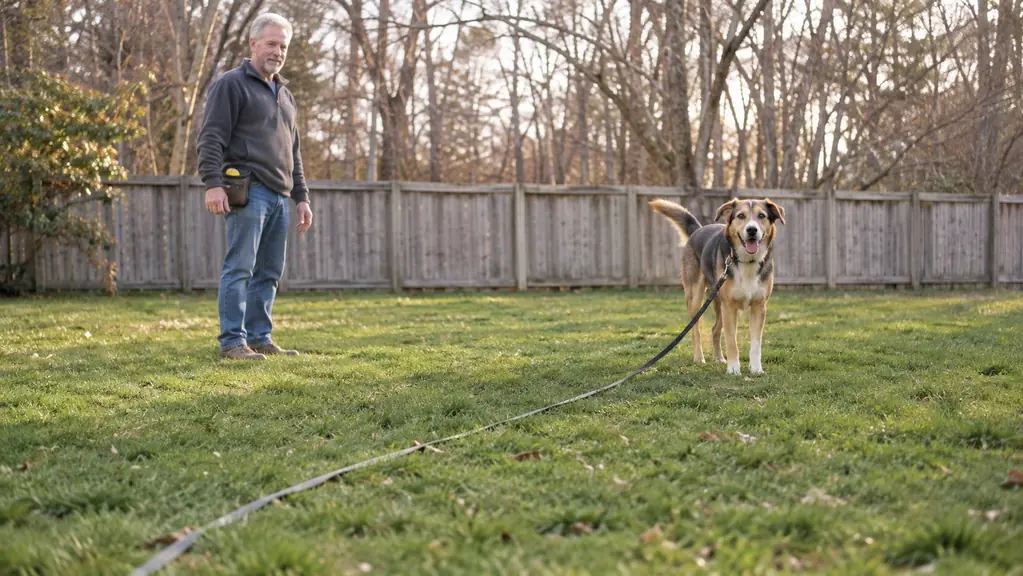
Biscuit came out of the county shelter at two years old with a big heart, no manners, and a recall that existed only in my imagination. I would say his name in the backyard, he would look at me like I had suggested a chore, and then go back to sniffing the fence line. For a while I thought the problem was him. It wasn't. The problem was that I was asking a dog to come to me from thirty feet away while he was attached to six feet of leash, which means I was asking him to do something he had never once practiced.
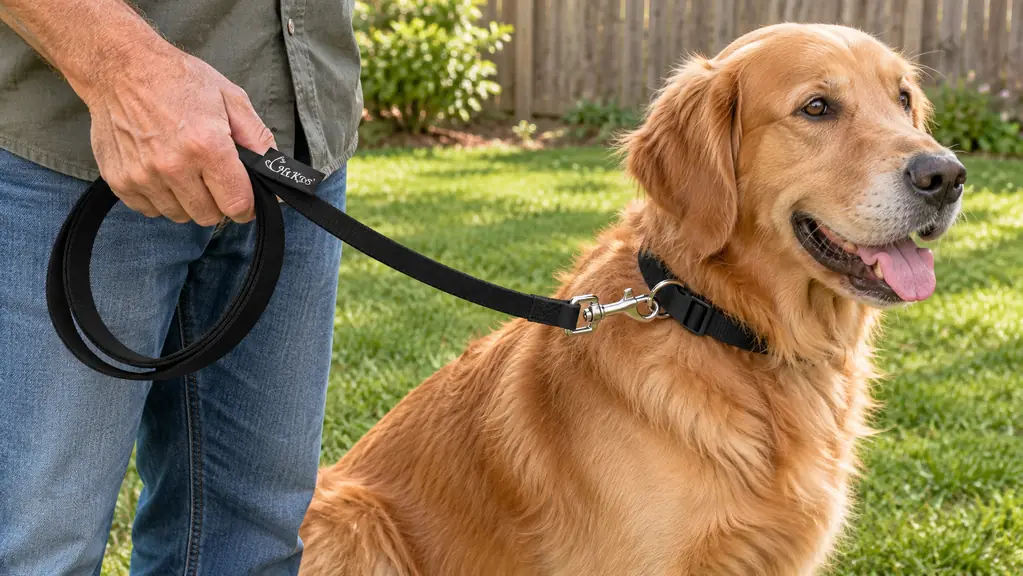
That is the whole case for a long line, and it is the reason I ended up with the Hi Kiss Dog Puppy Obedience Recall Training Lead. Fifteen feet of nylon, three quarters of an inch wide, with a swivel bolt snap on the end. No reel, no buttons, no handle. Just a longer rope and a dog who finally gets to make a real decision. Here are ten reasons that switch mattered for us, roughly in the order I noticed them.
The fifteen-foot line that made recall practice possible at all
Three quarters of an inch of nylon and a swivel snap. No moving parts to fail. Every one of the ten reasons below depends on this one piece of gear being in your pocket.
Amazon Check Today's Price on Amazon →Fifteen feet gives your dog an actual decision to make
On a six-foot leash, Biscuit never had a choice. I was close enough that the leash itself did the work, and he learned nothing except that being towed was normal. At fifteen feet he has to decide. He can come back to me, or he can stand in the grass and think it over. That thinking is where the training happens. A dog who chooses to return is a dog who has practiced returning, not a dog who got dragged.
You find out what your dog does when nobody is reeling him in
Three days in, I learned Biscuit's pattern. He would check in, drift out, check in again. That drift was invisible on a short leash because I was always right there correcting it without knowing I was doing it. Once I could see the drift, I could work on it. I started calling him back just before it happened, while he was still thinking about me, and paying him every single time. Two weeks of that and the drift got shorter on its own.
Three quarters of an inch of nylon is easy on older hands
I am sixty-one and my hands are not what they were after twenty-eight years of carrying mail. The Hi Kiss lead is three quarters of an inch wide, so it gathers into a loose loop without sawing at my fingers when Biscuit hits the end of it. It weighs next to nothing, which means it folds into a jacket pocket between sessions and Biscuit barely notices it hanging off his collar.
The swivel snap keeps the line from twisting into a knot
Any long line will corkscrew if the hardware does not turn with the dog. This one carries a swivel-style bolt snap, so when Biscuit circles and doubles back, which he does constantly, the line unwinds itself instead of building a knot every ten minutes. Sounds like a small thing. It is also the difference between a tool you use twice a day and one that ends up in a drawer.
It turns come into a habit instead of a once-a-walk command
On a short leash, come happens maybe one time in an hour. On a long line it happens ten or fifteen times in five minutes, because I can send him out and call him back over and over without leaving the yard. Repetition is the entire game. Biscuit did not learn recall because I explained it well. He learned it because he got called back a few hundred times in three weeks and it paid off every time.

You can practice outdoors without a loose dog
The places we walk want dogs on a leash, and I am not interested in being the fellow who argues about it. A long line lets me work at a distance that feels like freedom to Biscuit while he is still attached to me. That keeps us on the right side of the rules and keeps him safe near the parking lot by the trail head. Finding something that does both is harder than it should be.
Five minutes in the backyard beats an hour of guessing
My routine is short. Out the back door, three or four calls with treats, a little wandering, back inside. Five minutes, twice a day. The long line is what makes those five minutes worth anything, because there is room for him to move and room for me to be wrong. Long sessions wear him out and teach him nothing. Short ones, spread through the week, are what moved the needle for us.
It works the same on a puppy, a rescue, or a stubborn adult
I have not raised a puppy in thirty years, so I will not pretend to speak to that from experience. What I can tell you is that a two-year-old rescue with no training history took to it, and the neighbors' eight-year-old terrier who ignores everything took to it too when they borrowed my line for a weekend. Age is not the issue. Whether the dog gets to practice is the issue.
You add distance in steps instead of one big jump
Six feet, then ten, then fifteen. I moved Biscuit out a few feet at a time and only kept going while he came back on the first call. When he did not, we backed up and stayed at that distance another week. A long line gives you that dial to turn. A short leash is either on or off, and off is how dogs end up in the road.
Nylon outlasts the cotton leash that has been in my garage since 1994
I have a cotton leash in the garage that has stretched, frayed, and gone limp as a wet noodle. The nylon on the Hi Kiss lead has been dragged through wet grass, mud, and one patch of something I chose not to investigate. It still looks like the day it came out of the package. Whatever you buy for this job, buy nylon.
What I'd Skip
I would skip the retractable leash for this work, and I say that as a man who owned two of them. The constant tension teaches a dog to pull, and the lock button is a habit I would rather not depend on. I would skip anything with a chain on it, skip corrections altogether, and skip the idea that a dog who ignores you is being stubborn. Biscuit was not stubborn. He was unpracticed. There is a real difference between those two things, and only one of them is fixable with patience and a longer rope.
Fifteen feet of nylon did more for Biscuit's recall in three weeks than six months of me repeating his name in the backyard.
One length of nylon, a pocket of treats, five minutes a day
That is the entire program, and the Hi Kiss lead is the only piece of gear in it. Start with a few feet of slack, pay the dog every time he turns toward you, and work outward only when he gets it right on the first call.
Amazon Check Today's Price on Amazon →