
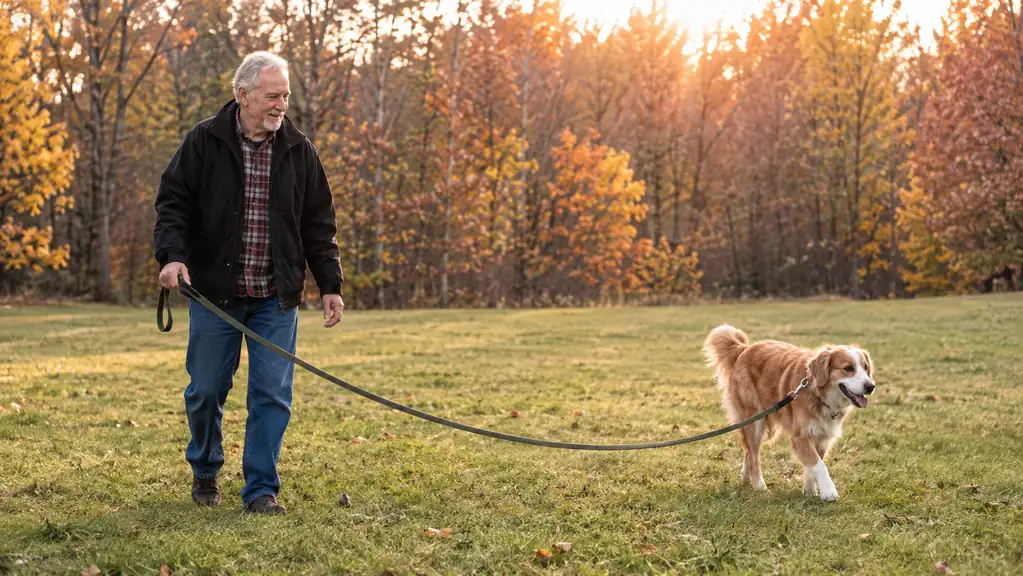
Biscuit came home from the county shelter at two years old, sixty-five pounds of Labrador mix with a strong opinion about forward motion. The first month I walked him on the same retractable leash I had used on every dog before him, mostly because it was already hanging by the door. One trip to the city park settled it. A leash that shortens itself every time the dog stops pulling is not teaching the dog anything. Biscuit learned to lean into the tension. I learned to grip a plastic housing until my knuckles ached. That was the week I switched to the Hi Kiss long lead, a fifteen foot nylon training lead, and stopped treating every walk as a negotiation I was losing.
Here is the short answer, before the details. The Hi Kiss long lead is a training tool. A retractable leash is a walking convenience. Those are two different jobs that happen to both involve a rope. If your goal is a dog who comes when called in an open field, the long lead does the teaching and the retractor quietly works against you. If your dog already walks politely and you want one hand free on a sidewalk, a retractor is fine and fifteen feet of webbing will feel like far too much rope to manage. I use both, for different things, on different days. The table below is where the two actually split.
| Hi Kiss Long Lead | Retractable Leash | |
|---|---|---|
| Length | A fixed fifteen feet, three quarters of an inch wide, the same distance every single session | Whatever length you hold with the thumb, so it changes on every step |
| Recall training | Built for it. The listing calls it a recall lead and that is exactly what it does | Not built for it. The cord reels in the moment tension drops, so the dog feels a pull that never quits |
| Everyday neighborhood walks | Fifteen feet of line on a sidewalk is a lot to manage near driveways and hedges | One hand, one thumb, nothing to gather. This is the job it was made for |
| Tangling and line burn | Flat nylon webbing you can see, grab, and step on without injury | Thin cord under the weight of a pulling dog, fast and hard on skin |
| If you drop it | A dropped line simply lies there and the dog steps on his own slack | A dropped housing clatters after the dog, which can spook a nervous rescue |
| Hardware life | Swivel style bolt snap resists twisting, snap closure, and nylon holds up better than cotton | Runs on an internal spring and a brake. When either quits, the whole unit is done |
| Storage | Coils into a bag, weighs 1.76 ounces, but fifteen feet of wet webbing needs looping | Clips to a belt and takes the space of a small flashlight |
| Learning curve for the human | Plan on a week of tripping over your own line before it feels natural | Nobody has ever needed a lesson to use one |
| Best for | Teaching recall and giving a dog room to think in grass or a field | A dog who already walks loose on a short leash |
Read the winner column honestly, because I wrote it honestly. The long lead does not take every row, and a comparison where it did would be worth nothing to you. A retractable wins three of these outright and ties on one. If that surprises you, good. The rest of this only makes sense if you believe the table.
Where the Hi Kiss Long Lead Wins
The first advantage is a length that does not change. Fifteen feet. Not fourteen, not eleven when the dog slows down, fifteen, every time you unclip it from the collar. That consistency is the entire point. A dog on a fixed line learns where the edge is, and once the edge stops moving, the dog stops testing it. On the retractor the edge moved constantly, and Biscuit spent two years testing it because there was always a chance the answer would come out different. Four weeks on the long lead and he had a working picture of where the rope ran out. Nothing mysterious about it. The rope just told him the same thing every time.
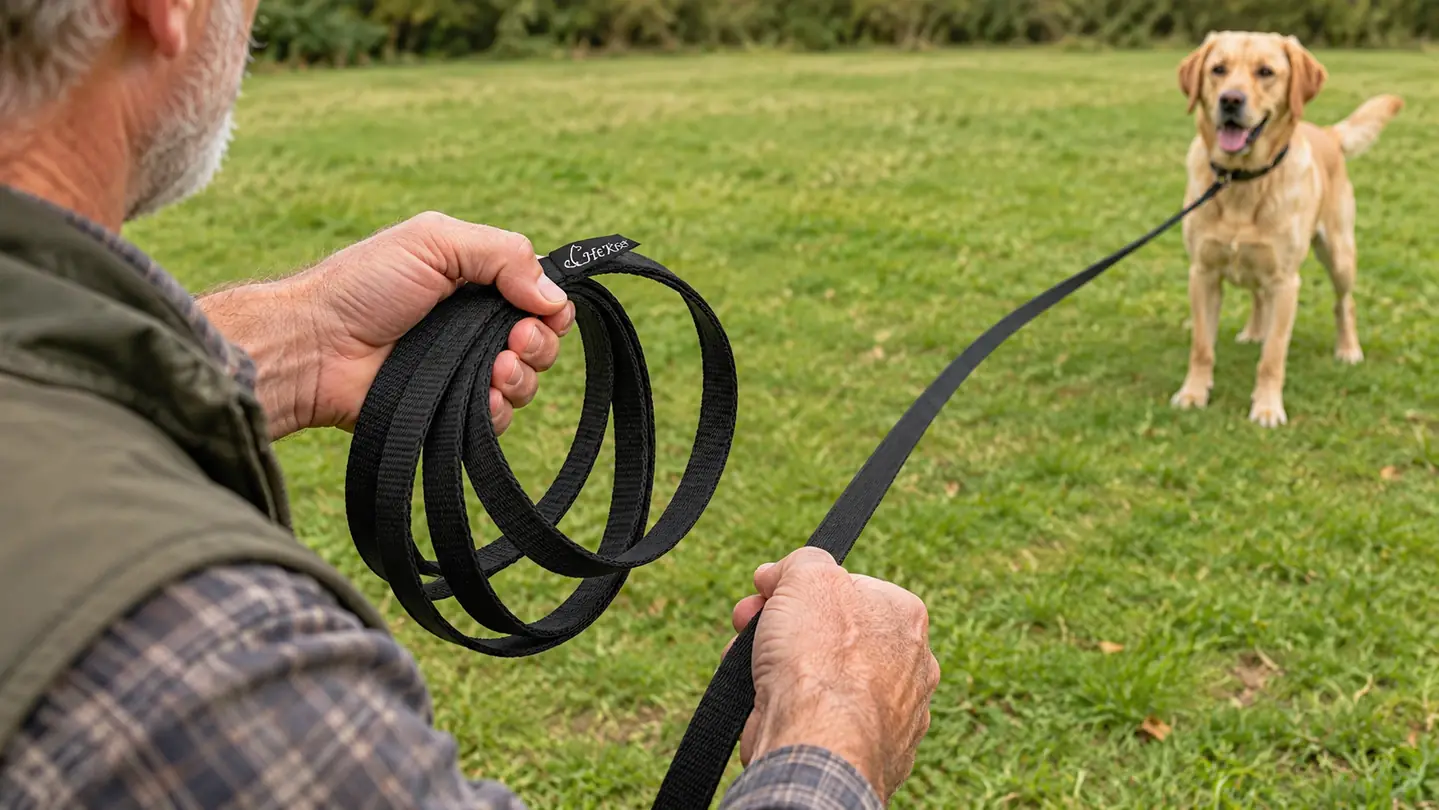
The second advantage is what the line is made of. Three quarters of an inch of flat nylon webbing is something you can see out of the corner of your eye, grab without thinking it through, and step on if you have to. The listing says it outlasts cotton, and after a Missouri winter of wet walks through ditch grass I believe it. More to the point, flat webbing does not slice. A retractable cord loaded with a pulling dog is thin, hard and moving fast. I had one wrap the back of my knee once when Biscuit bolted at a squirrel. That was the last time I used it on him.
The third advantage is the hardware, and it matters more than it sounds like it should. The Hi Kiss uses a swivel style bolt snap, which resists twisting, with a snap closure. That does not sound like much until you have walked a dog who spins at the end of a line every time another dog appears. A clip that will not twist itself loose is the difference between a training session and a phone call to the neighbor about a loose Lab in her yard.
Where a Retractable Leash Wins
I am not going to pretend the retractor has no use, because I still own one. On a sidewalk, on a block with driveways and hedges and a mail truck idling at the curb, a retractable is a one handed tool. Thumb on the brake, other hand in your pocket, dog three feet ahead. There is no loop to gather, no webbing to coil, nothing to trip over on the way down the driveway. On the streets where I actually live, that counts for something.
Storage is the other honest win. The whole unit clips to a belt and takes up the space of a small flashlight. The long lead, when Biscuit is finished with it, is fifteen feet of damp webbing that has to be looped, and looped properly, or it goes back in the bag as a knot. It weighs next to nothing at 1.76 ounces, but weight was never the issue. Length is the issue.
And the learning curve favors the retractor by a mile. Nobody needs a lesson to use one. The first week I had the long lead, I tripped over it twice in my own driveway and once let it pool around my ankles while Biscuit walked a slow circle around me looking pleased with himself. There is a skill to handling fifteen feet of line, and the dog is not the one who has to learn it.
See the lead that taught Biscuit where the edge is
Fifteen feet of nylon webbing, a swivel bolt snap, and twenty-two thousand reviews from people doing the same ten minutes a day that I did. Check today's price on Amazon.
Amazon Check Today's Price on Amazon →What Fifteen Feet Actually Feels Like
People hear fifteen feet and picture more freedom than it really is. In a fenced backyard it is generous. At the city park, on open grass away from the walking path, it is exactly right for recall work, which is what the lead was made for. On a narrow sidewalk it is a nuisance, and I do not use it there. Fifteen feet of line on a sidewalk means your dog is either in somebody's petunias or wrapped around a signpost, and neither one is a training failure. It is the wrong tool for that surface. I keep the long lead for grass and open ground, and a plain six foot leash for the block.
There is a physical rhythm to it as well. You gather slack in loops as the dog comes toward you, and you let it out as the dog moves away, and your hands are busy the whole time. That is not a flaw in the design. That is the design. The line is supposed to be something you stay in contact with, so that a recall means the dog turns and comes back to you rather than the dog turning because the rope finally ran out. Once that rhythm became habit, my hands stopped feeling busy and started feeling like they were having a quiet conversation with the dog.
One thing I would tell anyone starting out: pick the line up. A long lead lying on the ground is a trip hazard for the dog and for you, and a dog tangled in his own lead learns that coming when called is unpleasant. Keep the slack in your hand, even when it is awkward.
Four weeks on the long lead and he had a working picture of where the rope ran out. The rope just told him the same thing every time.
The Two Mistakes I Made First
The first mistake was using the long lead on the street. I was so pleased with how Biscuit behaved in the yard that I took the fifteen footer straight out to the sidewalk and spent twenty minutes managing rope instead of watching for cars. The lead is a training tool, and training goes better where there is room. My rule now is grass for the long lead, concrete for the short one.
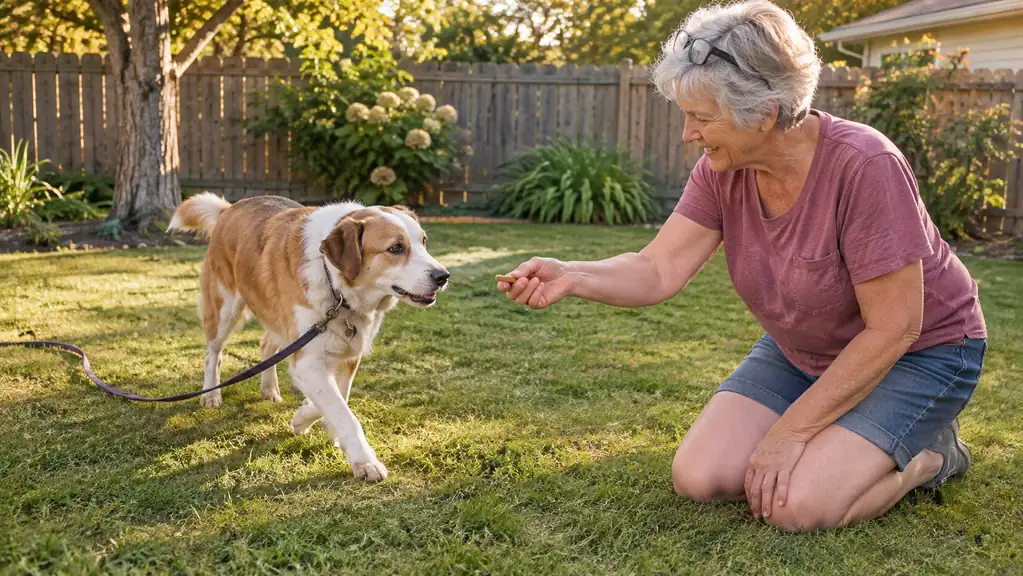
The second mistake was expecting the lead to do the work. It does not teach recall. It gives you a safe way to practice recall, over and over, with treats and a cheerful voice, until the dog decides that coming back to you is the better end of the deal. Twenty-two thousand reviews on this thing and not one of them says the rope trained the dog. What they say, and what I would say, is that the rope made the practice possible without a fence.
Care and Keeping
Nylon webbing and wet grass do not love each other. Mine comes home damp most of the year, so I rinse it in the utility sink, hang it over the porch rail, and let it dry before it goes back in the bag. Six months of that and the webbing has not frayed, the snap still closes with a solid click, and the swivel still turns freely. The listing calls the material durable and says it outlasts cotton, and my experience matches, though I would not leave any nylon lead soaking in a bucket for a week and expect it to forgive me.
The snap closure is the part that wears first on any lead, so check it. I look at the gate of the clip every couple of weeks the same way I used to check a trailer hitch on the mail truck, which is to say quickly and without ceremony. If it ever stops springing shut on its own, that lead is finished. Cheap to replace. Expensive to explain to the neighbor whose dog is now standing in the road.
What I Liked
- Fifteen feet of fixed length, so a dog finally learns where the edge is
- Three quarters of an inch of flat nylon webbing you can see, grab and step on
- Swivel style bolt snap resists twisting when a dog circles at the end of the line
- Light enough to coil and carry at 1.76 ounces, and it survives wet weather
Where It Falls Short
- Fifteen feet is too much line on a sidewalk, and I stopped pretending otherwise
- Takes two hands and about a week of practice to handle cleanly
- No brake, no lock, no shortcuts. You are the brake, and that is the whole point
Who Should Buy Which
Buy the Hi Kiss long lead if you have a dog who pulls, a dog who ignores you at the park, or a rescue who is still learning that people are worth coming back to. Buy it if you are willing to spend ten minutes a day, two or three times a day, in a yard or a field, with treats in your pocket and a happy voice. That is the entire program. It is not complicated, but it is also not passive, and the lead only helps on the days you actually pick it up.
Buy a retractable leash if your dog already walks on a loose leash and your goal is a convenient loop around the neighborhood with one hand free. It is a fine piece of equipment for that job and I still keep one in the truck for the vet's parking lot. Where I would draw the line is using one as a training tool on a dog who pulls, because the mechanism rewards the pull. Every time the dog leans into the cord, the cord pays out a little more line. From the dog's side of things, leaning works. That is the opposite of what you want him to learn.
If you are somewhere in the middle, buy both and use them for what they are good at. A short leash for the block, the fifteen footer for the park on a Saturday morning. That is what hangs by my door now, and it is the arrangement I would recommend to any neighbor who asked me over the fence.
Ten minutes a day in the grass is the whole program
Fifteen feet of nylon webbing and a swivel snap. No brake, no lock, no shortcuts, just a fixed length that tells your dog the same thing every single time. Check today's price on Amazon.
Amazon Check Today's Price on Amazon →