
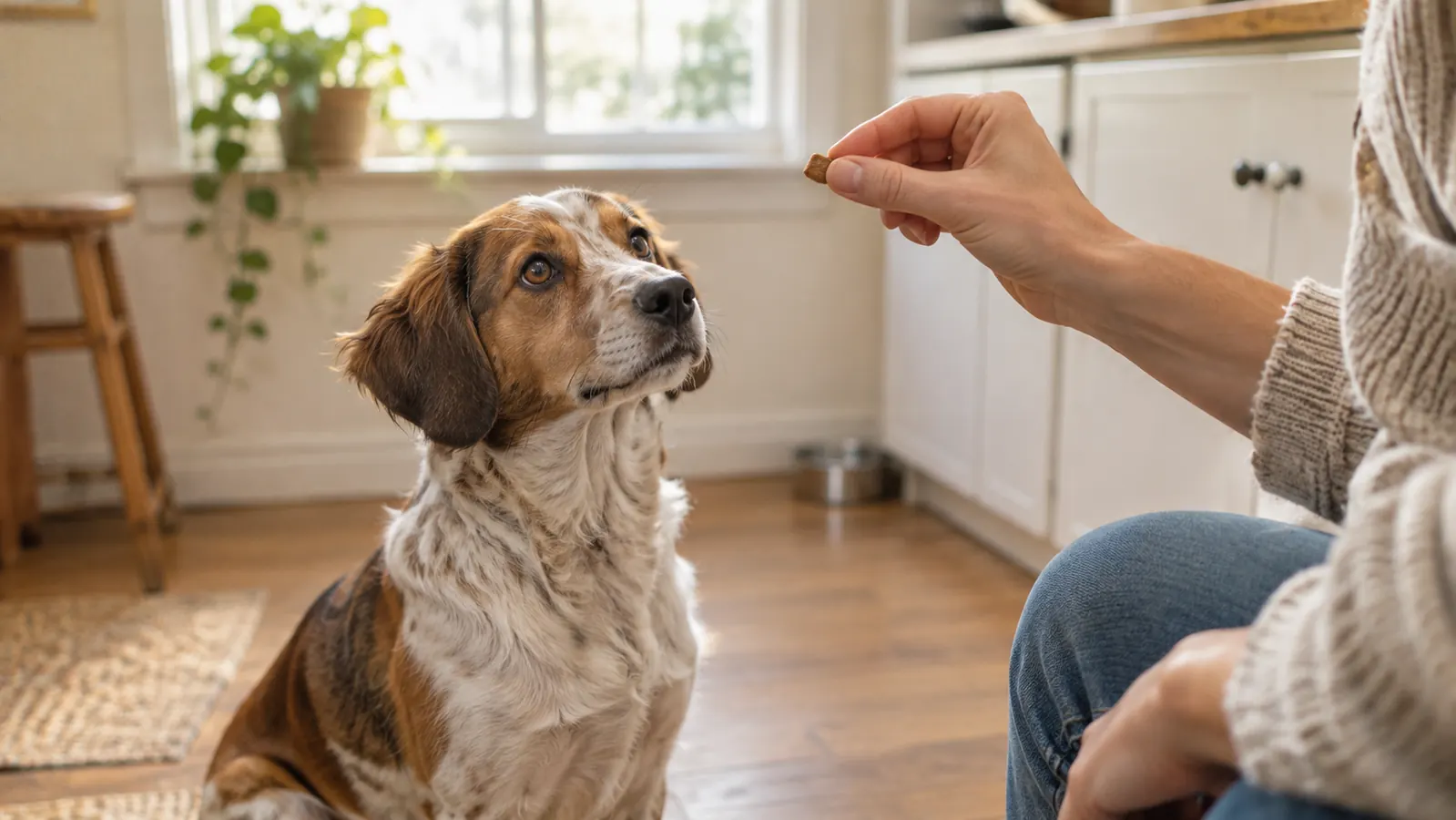
Biscuit came home from the county shelter at two years old, sixty-five pounds of Labrador mix with a hard pull on the leash, a jumping habit, and no idea what the word sit meant. I was sixty-one and twenty-eight years into a walking mail route, so I figured I had met every kind of dog there is. I had not met one who could care so little about a piece of kibble. That was my first mistake, using his own dinner as a reward. He would take it, drop it on the rug, and look at me like I had wasted both our time. A neighbor handed me a handful of Blue Buffalo Bits, and the whole thing changed inside of a week.
Here is what I have figured out since, mostly the hard way. A training treat is not really food. It is a tool. It has to be small, it has to be soft, and it has to be worth more to the dog than whatever else is happening in the yard. Get those three things wrong and you spend a month arguing with a dog who is not ignoring you on purpose. There is simply nothing in it for him. What follows is my list, in the order I would explain it to a neighbor over the fence.
The bag that lives in my jacket pocket, not the pantry
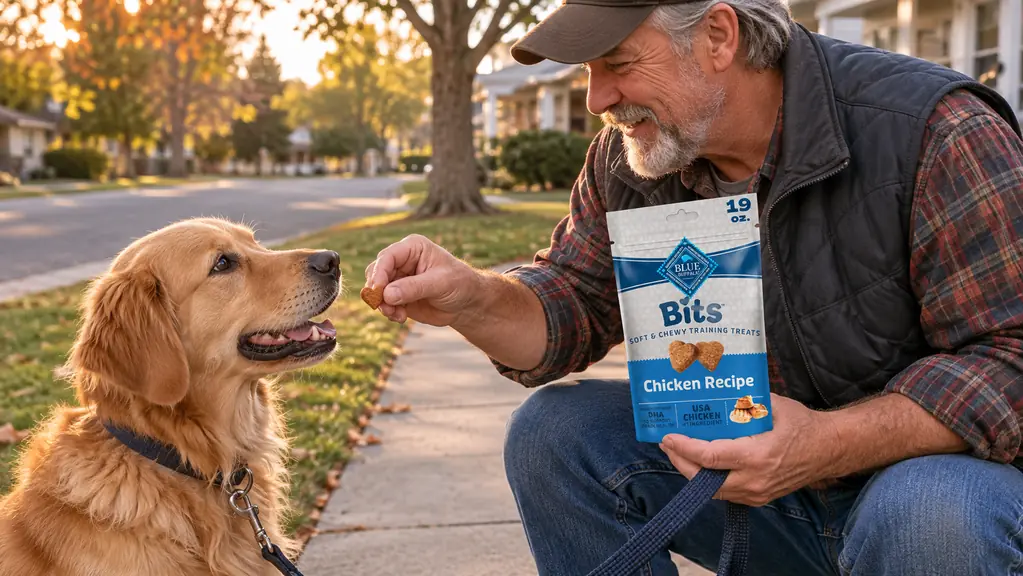
Small, soft chicken bits that go down in one motion so the reward lands while the dog is still doing the right thing. This is the one I keep on the hook by the back door.
Amazon See the chicken recipe on Amazon →He swallows it before the next command
A hard biscuit costs you four or five seconds of crunching. That sounds like nothing until you count it across a fifteen-minute session. Soft-moist bits go down in one motion, so the dog is back in position and ready before the moment passes. Timing is the whole ballgame in reward training. If the reward lands after he has stood up and wandered two steps, you have just paid him for wandering. Blue Buffalo Bits keep that loop tight enough that he can still connect the sit to the payoff.
Real chicken leads the ingredient list, and the dog knows it
I have tried the bargain bags. The dog can smell the difference before I get the bag open. Real chicken is the first ingredient in Blue Buffalo Bits, and that is why the thing gets his attention from across the yard. It is not a bribe, it is a signal. Somewhere in the first couple of weeks Biscuit worked out that the little soft pieces only showed up when we were working, and he started showing up for work.
You can pinch one in half and get two rewards
One bag does the work of two if you are willing to use your fingers. Soft bits split cleanly, so a single piece becomes two paydays. For a young dog learning something brand new, that means you can pay him twice for the same good choice. For an older dog, it means the reward is small enough that he is not still chewing while you are trying to give the next cue. Small soft treats are the cheapest way I know to buy yourself more repetitions in the same five minutes.
Small rewards let you reward often
A dog learns from frequency, not from volume. If every reward is a mouthful, you can only hand out a few before the session is over and his stomach is full. Small bits let you go twenty or thirty times in a short session, and the dog stays keen instead of getting stuffed and bored. Three or four short sessions a day have done more for Biscuit than one long class ever did. Ten minutes in the kitchen beats an hour you keep putting off until Saturday.
It still counts out at the park
Kibble works in the kitchen. At the park, with a squirrel in one tree and two other dogs and a jogger coming up the path, kibble may as well be a rock. The reward has to outbid the environment, or the environment wins every time. That is why these go in my pocket for walks and not just for sit-down practice at home. The behavior you have in your kitchen is not the behavior you have until you have practiced it where the distractions actually live.
The smell buys you three useful seconds
I do not know what a dog smells in a soft chicken bit, but I know what it does to his face. The moment the bag rustles, Biscuit's ears come forward and his eyes come up to mine. That is the three seconds you need to ask him for something. Call it a bribe if you like. Attention is the raw material of every training session, and a treat that produces attention before you have said a word is worth keeping within reach.
Easy on hands that are not twenty anymore
My hands are sixty-one years old. They have delivered mail through ice storms and August afternoons, and they do not work the way they did at forty. Crumbly treats end up in the pocket lining. Hard treats are hard to snap in half without a countertop. Soft bits are easy to hold, easy to hand over, and easy to get out of a jacket pocket in a cold wind. If you are in my age bracket and training a dog, that counts for more than any theory about reinforcement schedules.
One bag covers a long stretch of short sessions
Nineteen ounces of small bits goes a long way when each reward is one small piece. I opened my first bag in March and I am not through it yet, and I train three or four times a day. That is a practical thing rather than a selling point. When you are working a dog every single day, you want the supply to outlast your patience. This one does, which means I am not rationing treats or skipping a session because I am nearly out.
Corn-free, wheat-free and soy-free, one less thing to guess at
Biscuit has a stomach that files complaints. The bag says corn-free, wheat-free and soy-free, and we have not had a bad night since we switched. I am not a vet and I am not going to sit here and tell you a treat fixes anything. But when you are handing out thirty of something in one session, you want to know what is in them. Fewer ingredients I cannot pronounce is a fair place to start, and the rest of the bag is simple enough to read out loud.
A little nutrition rides along with the training
Blue Buffalo adds DHA, an Omega-3 fatty acid, and includes flaxseed for Omega 3 and 6 fatty acids that support skin and a shiny coat. I am not going to pretend a treat is a supplement, and nobody should buy a bag because of a line on the back. But if your dog is getting a dozen of these a day, it is a decent thing that they bring something along with them besides a good mood and a wagging tail. It is a training treat first. The rest is a bonus.
What I'd Skip
I would skip the big crunchy biscuits for training. They take too long to eat, they cost too much per reward, and half of them end up as crumbs in the truck seat. I would also skip the trick of using his regular dinner as a reward unless it is genuinely working, which for us it was not. And I would skip the notion that buying a better treat is the same thing as training. It is not. The bag does not teach the dog anything. You do, five minutes at a time, over and over, for months.
One honest gripe about the soft ones. They are soft, so they do not survive a loose pocket or an open bag left on the counter. Keep them in a baggie and clip the top shut, or you will be scraping bits out of the laundry. That is the whole tradeoff, and it is a small one to make for a treat that keeps a dog's head in the game.
Three weeks after I quit using his dinner as a reward, Biscuit sat on the first ask in the middle of the yard. Same dog. Same yard. Different treat.
Start with a bag, a pocket and five minutes
You do not need a training program, a clicker and a weekend seminar. You need a small soft reward, a dog who wants it, and a few short sessions a day. That is how it finally started working at our house.
Amazon Check the chicken recipe on Amazon →