
Short answer: they do different jobs, and I would not want to give up either one. Blue Buffalo Bits are what I reach for when Biscuit needs to know something good just happened, right now, in a place with squirrels in it. Plain kibble out of his daily ration is what I reach for when we are drilling something he already knows in the backyard. One buys attention. The other keeps his waistline where it is.
Give me a minute before you write that off as a fence-sitting answer. I am 61, I spent 28 years walking a mail route here in Sedalia, and I have met just about every kind of dog there is through a screen door. What I know about training comes from one group obedience class at the pet store, a stack of library books, and a great many short sessions in my kitchen with a 65-pound Labrador mix who had never been taught a blessed thing before we adopted him at age 2. When Biscuit came home he pulled me off the porch steps, jumped on June's sister, and treated the city park like an all-you-can-smell buffet. Food was the first thing that ever got through to him. Which food mattered more than I expected.
Two Very Different Things in Your Pocket
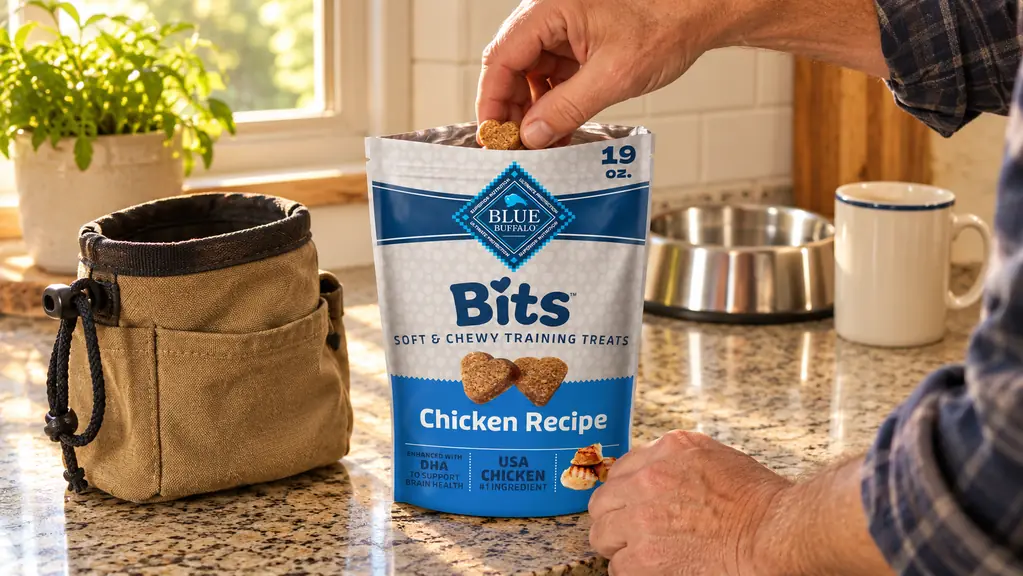
Blue Buffalo Bits are soft-moist training treats, and the bag in my jacket pocket is the 19-ounce chicken recipe, which comes in at just over a pound. Real chicken is the first ingredient. They carry DHA, an Omega-3 fatty acid that supports cognitive development, along with Omega 3 and 6 fatty acids from flaxseed for skin and coat. They are corn-free, soy-free and wheat-free, and Blue Buffalo makes them for all breed sizes. Sixteen thousand reviews and a 4.7 average is the kind of number that makes a person suspicious, so I will say plainly that they are still just treats. They do not train the dog. They make training possible on the days the dog would rather be doing something else.
Kibble rewards are not a product at all. They are a habit, and if the term is new to you, it means exactly what it sounds like. You measure out your dog's daily food, set a portion aside, and pay it out during training instead of putting all of it in the bowl at mealtime. Plenty of trainers recommend it, especially with puppies, and the reasoning is hard to argue with. The dog is working for food he was going to eat anyway. Nothing extra goes into him, and nothing extra comes out of your wallet.
Both of those things are true, and I still ended up with a bag of Blue Buffalo Bits in every jacket I own. That is because training a dog in a kitchen and training a dog in the world are two different jobs, and the two kinds of reward are suited to different jobs. Here is how they stack up on the things I actually care about.
A fair comparison also has to say what a session looks like at my house. Mine are short. Three or four minutes in the kitchen before I have my coffee, five minutes in the backyard after lunch, and whatever the evening walk turns into. On a heavy day that is thirty or forty rewards. The choice of what goes in the pouch is the difference between a dog who is still with me at minute four and a dog who has wandered off to inspect the fence line.
| Blue Buffalo Bits | Kibble Rewards | |
|---|---|---|
| What it is | Soft-moist chicken training treats sold as treats | A portion of the dog's daily food, set aside from the bowl |
| Speed of reward | Eaten in a second or two, so the next repetition starts right away | Gets crunched, and a working dog often drops part of it in the grass |
| Worth in the dog's eyes | Reserved for good behavior, so it competes with distractions | The same food as every meal, so it competes with everything else |
| Ingredients | Real chicken first, DHA and flaxseed, corn, soy and wheat free | Whatever the dog's regular food is, for better or worse |
| What it costs you | A bag you have to buy and replace | Already in the bin by the back door |
| Calories | Extra on top of meals unless you cut the ration back | Comes out of the daily ration, so nothing extra |
| Best for | New behaviors, recall, and anywhere with noise and other dogs | Home drills, high repetition, and dogs on a strict diet |
Where Blue Buffalo Bits Wins
The first advantage is speed, and it matters more than people think. A soft piece is gone in a second or two, and we are on to the next repetition while the dog still has the taste in his mouth. Kibble gets crunched. A dog who is thinking hard will drop half of it in the grass and then spend ten seconds hunting for it, and by then the moment I was trying to mark is long gone. When you are teaching something new, you are trying to connect a behavior to a consequence inside about a second. The food that disappears fastest wins that race.
The second advantage is what the food is worth to the dog. Biscuit gets kibble twice a day, every day, from the same bowl, in the same corner of the kitchen. It is the least interesting thing that happens to him. Blue Buffalo Bits only show up when he has done something right, and they show up in places where he is in over his head, like the parking lot at the pet store or the busy side of the city park. That is why he will hold a sit on a wet sidewalk for a piece of chicken and will not hold it for a piece of his dinner. The treat is not better food. It is better information.
The third advantage is that the ingredients are actually written down and worth reading. Real chicken first, no corn, no soy, no wheat. I am not going to tell you a treat fixes a bad coat, but when I am handing a dog forty pieces of something a day, I would rather it be something I can pronounce. Kibble rewards are only as good as the kibble, and a lot of inexpensive food is not much more than filler with a picture of a chicken on the bag.
Where Kibble Rewards Wins
Kibble wins the money argument without breaking a sweat. You already bought it. It is sitting in the bin by the door. For a household working a puppy through a dozen repetitions an hour, or a family watching the grocery budget, that is not a small thing, and I am not going to pretend a bag of treats is free. It also wins the calorie argument. Kibble taken out of the daily ration adds nothing to the dog's day. Treats are extra, and extra adds up over a year, especially in a dog who is already carrying a few pounds he does not need.
The other place kibble wins is sheer volume. Teaching a reliable recall on a long line can take forty or fifty repetitions in a single afternoon. Forty pieces of anything is a lot of food, and that is before the neighbors start practicing with him over the fence. There are also dogs who cannot have the treats at all, whether because of a sensitive stomach, a prescription diet, or a vet who has put the dog on a strict plan. For those dogs, using part of the daily ration is not a compromise. It is the only sensible answer.
And I will say this for kibble: it is honest. A dog who will work for his own dinner is a dog who is paying attention to you, not to the bag. If your dog will sit, come and walk politely for plain kibble in your own backyard, you have a better-trained dog than half the people I see at the park with a pocket full of hot dog. The treat did not do that. You did.
Biscuit will sit for kibble in my kitchen. He will sit for Blue Buffalo Bits in the pet store parking lot with a shopping cart rattling past him. Same dog, same cue, different address.
The reward that still works when the address changes
If your dog is brilliant in the kitchen and deaf on the sidewalk, the problem is usually what is in your hand. Blue Buffalo Bits are what come out of my pocket when we are somewhere new and he needs a reason to check in with me. 19-ounce bag, real chicken first, corn, soy and wheat free.
Amazon Check Today's Price on Amazon →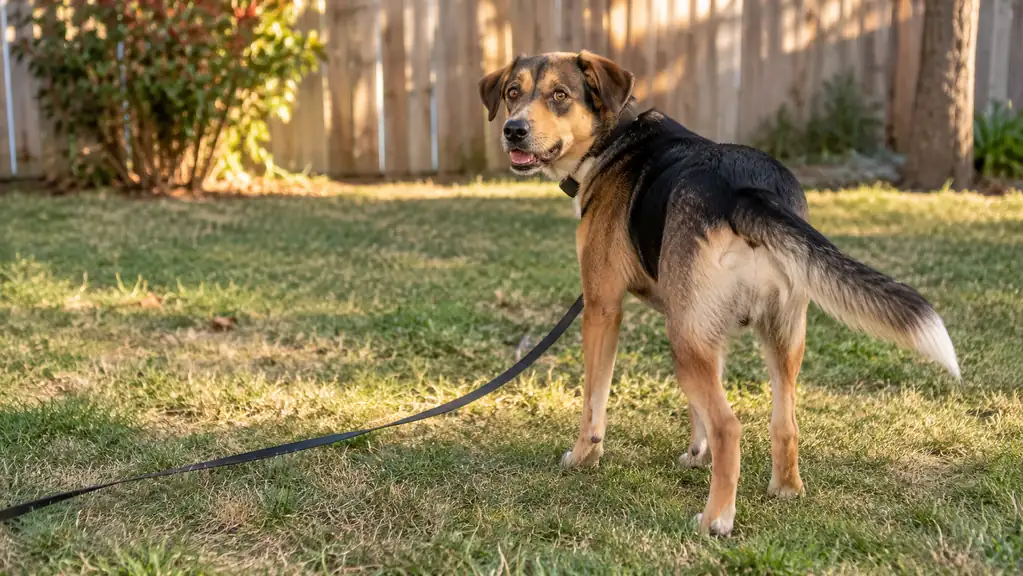
The Half-and-Half Method I Actually Use
What I do is not a choice between the two. It is a division of labor, and it took most of a year to settle on it. Kibble handles the practice. Bits handle the performance.
In the backyard, working on a stay or a name response or the umpteenth round of loose-leash walking, Biscuit gets kibble out of the ration. There is no real distraction to beat, the repetitions are many, and the calories stay where they belong. When we go somewhere with noise and other dogs and people who want to pet him, the treat pouch comes out and it is Blue Buffalo Bits all afternoon. I break each piece in half as well. A Labrador does not need a whole piece to know he did well, and half a piece means twice as many rewards out of the same bag.
One more thing I got wrong for months. I used to hand the food over and then praise him. Better to say the word first, in a calm voice, and then deliver the food. The word becomes the thing he is waiting for, and eventually the word works in places where I have forgotten the pouch entirely. That is the whole point of any of this, and it is why I do not worry much about which treat is best in some absolute sense. The treat is a loan you take out and then slowly pay back.
What About the Dog Who Could Not Care Less About Food?
Not every dog is Biscuit. My sister has a terrier who will walk away from a piece of steak. If that is your dog, no treat on any shelf will fix it, and the honest answer is to find out what your dog actually wants and pay him in that. A tennis ball. A squeaky toy. Five seconds of tug. One good sniff of the neighbor's hedge. Some dogs will work harder for a sniff than for a sandwich.
The same logic still applies, though. Whatever your dog loves most is what you use for hard, new, distracting work. Whatever he likes least is what you use for the boring repetitions at home. Soft treats are convenient because most dogs are wired to care about food and because a treat is quick to deliver, but they are a tool, not a rule. No bag of anything is a substitute for showing up four times a day for three minutes.
Who Should Buy Which
Buy Blue Buffalo Bits if your dog is food motivated, if you are teaching anything new, or if you train anywhere other than your own kitchen. Buy them if your dog is young, distracted, or newly adopted, and if the job for the next few weeks is getting his attention before you can teach him a thing. The 19-ounce bag lasts me a couple of months because I break the pieces, and it lives in a jacket pocket, the car console and the drawer by the back door, so there is always a handful within reach when the moment shows up.
Stick with kibble rewards if your dog is on a prescription diet, if the vet has asked you to watch his weight, if you are running high-volume repetition drills at home, or if money is tight and you would rather put it toward a good long line and a collar that fits. And use both if you are where I am, which is a dog who is reliable in his own yard and still learning how to behave out in the world. That is not a failure. That is where most of us live.
Start with the bag that goes everywhere with you
Nineteen ounces, real chicken first, and soft enough that a dog can eat one and get straight back to work. Keep a handful in your jacket and the next walk turns into a training session instead of a wrestling match.
Amazon Check Today's Price on Amazon →