
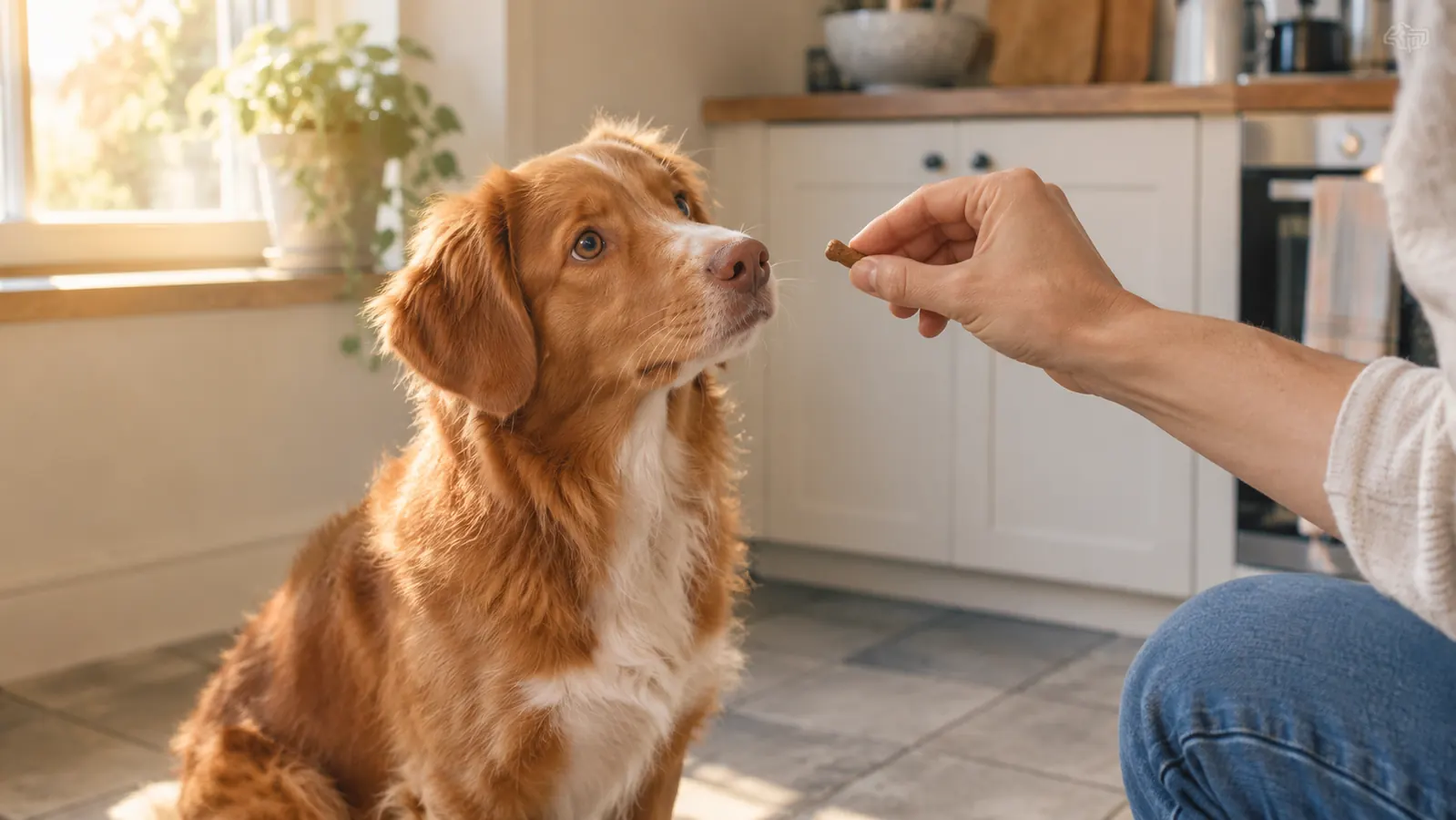
The first month I had Biscuit, I bought a big bag of crunchy biscuits because that is what the pet store had stacked by the register. He liked them fine. He also took eight seconds to chew one, lost interest halfway through, and wandered off while I was still saying the word sit. By the time he swallowed, whatever he had done to earn it was gone from his head. That is the whole problem with hard biscuits for training, and it took me about two weeks and one wasted bag to figure it out.
So I switched to soft treats. Blue Buffalo Bits, chicken recipe, the 19-ounce bag. I have been using them as my main training reward for months now, through leash work in the driveway, recall in the fenced backyard, and one group obedience class at the pet store in town. This is what I actually found over daily use, including the parts I do not love and the parts that made me look at other brands.
The Quick Verdict
Soft enough to finish in a couple of seconds, real chicken first on the label, and Biscuit works for them every single session. The bag is bulky, the zip strip gives out, and the pieces clump in summer humidity. Nothing else I tried held his attention this well.
Amazon Check Today's Price →The treat Biscuit will still work for after months of daily sessions
Blue Buffalo Bits, chicken recipe, in the 19-ounce bag. Soft, small enough for repeat rewards, and made with real chicken as the first ingredient. Check today's price before you decide.
Amazon Check Today's Price on Amazon →How I've Used It
I am not a trainer. I am a retired mail carrier who walked a route for 28 years and met every kind of dog on it, which taught me a lot about reading a dog and nothing at all about training one. Biscuit came from the county shelter at age 2, about 65 pounds, and he pulled hard on the leash, jumped on guests, and pretended not to hear me at the park.
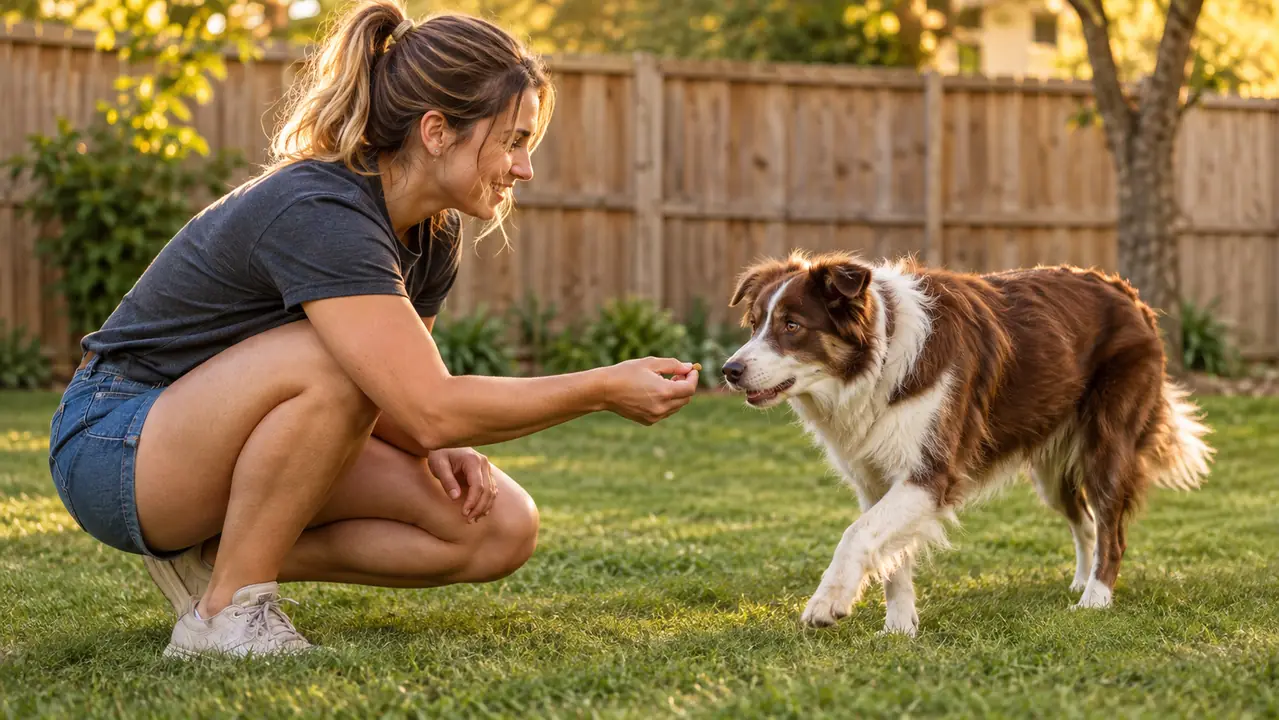
What I do now is short sessions. Three or four a day, five minutes each, mostly on the kitchen tile and on the grass out back. Sit, down, stay, come, and a good deal of loose-leash practice on the sidewalk in front of the house. Every one of those repetitions gets a treat. On a five-minute session I might hand out 15 or 20 pieces, which means how fast the dog can finish the reward matters a lot more than how fancy the reward sounds on the bag.
That is the reason Blue Buffalo Bits stayed. One piece takes Biscuit maybe two seconds. With a hard biscuit I was standing there waiting while he crunched, and by the time he was done he had forgotten what he did to earn it. With these the loop closes fast: he sits, he gets the treat, he is ready for the next one.
Before this I tried sliced hot dogs. Cut them into coins, kept them in a baggie in the fridge, and for about four days they were the best thing that had ever happened to Biscuit. Then he started getting loose stools, June told me to knock it off, and she was right. I tried string cheese next, which worked fine for about a week until it turned greasy in my hand and left a film on the sidewalk. The string cheese also made him gassy enough that the truck ride to the park got unpleasant. What I wanted was something in between: soft and fast, but built as dog food instead of people food.
The class at the pet store is where the difference really showed. Six dogs in a circle, an instructor talking, and about forty minutes of waiting around for your turn. Biscuit is not a patient dog under the best conditions. I had a pocket full of Blue Buffalo Bits and I spent them one at a time for four solid weeks of sitting quietly while the beagle next to us lost its mind. The dog across the circle had a bag of something hard and dry, and his owner spent most of the hour crouched down trying to get the dog's nose back off the floor. Small soft pieces kept Biscuit's head up and his attention on me, which is the only reason we got through the six weeks.
What's Actually in Them
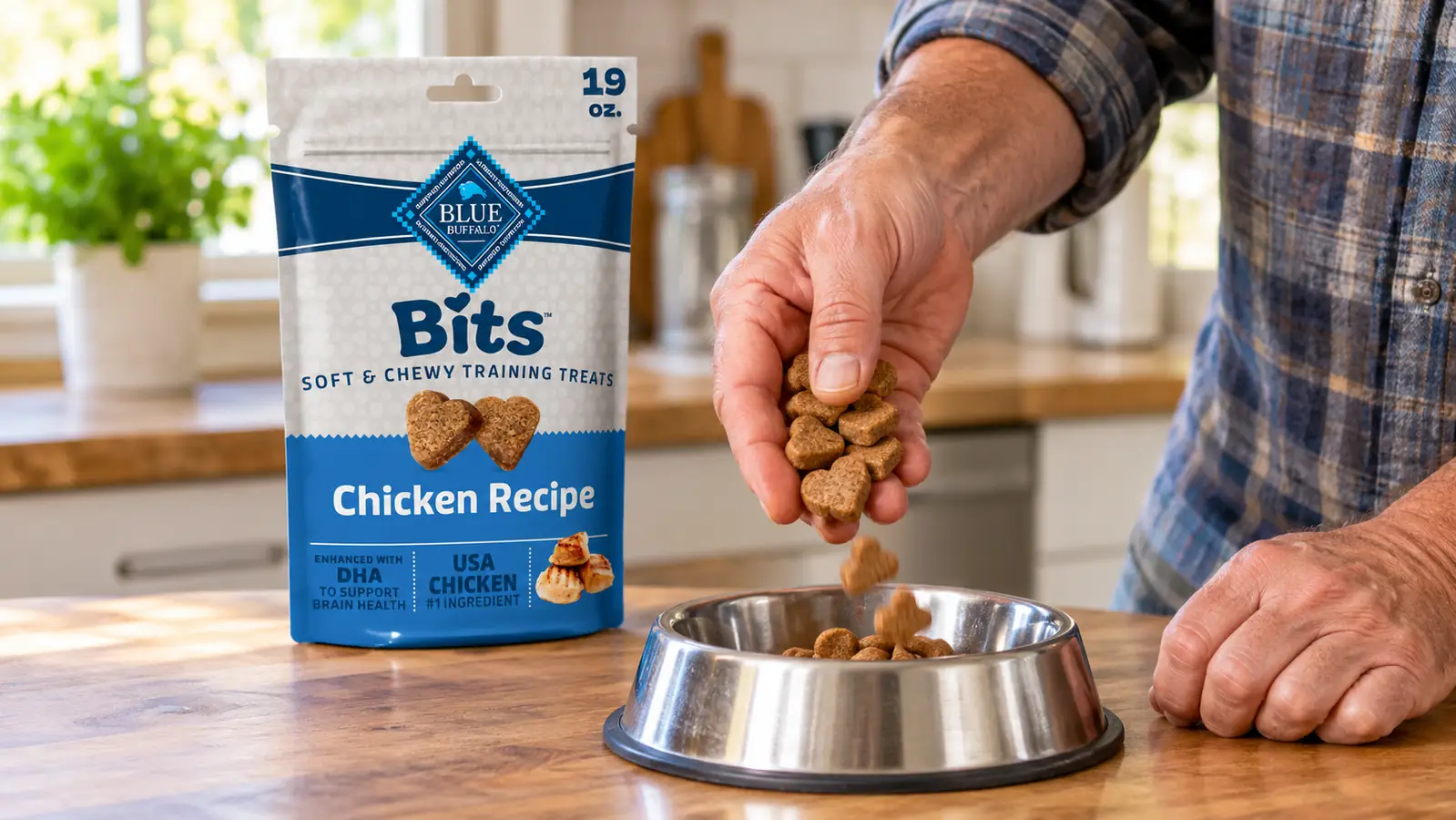
Real chicken is the first ingredient. The label lists DHA, an Omega-3 fatty acid, along with Omega 3 and 6 fatty acids from flaxseed for skin and coat. They are corn-free, soy-free, and wheat-free. I am not going to pretend I can see a shinier coat from the couch, and I do not have a lab to run a test in. What I do like is that the first thing on the list is chicken and not a grain or a syrup.
The bag is 19 ounces, the pieces are small pellets, and they are soft-moist rather than baked hard. That softness is the entire point for training. A treat that takes a second to swallow keeps a session moving. A treat that takes ten seconds turns a five-minute lesson into three minutes of chewing and two minutes of actual work.
Here is the honest part about soft treats, and it applies to these as much as to any other brand. They are not clean. They leave a little residue on your fingers, and if you keep a handful loose in your jacket pocket they will eventually mush into the lining. I keep mine in a small plastic container now, the kind that holds maybe a cup and a half, and I rinse it out every week or so.
The size is right where I want it. I counted once, out of curiosity, and got a little over 200 pieces out of a fresh 19-ounce bag. That matters more than it sounds. At 20 pieces a session and four sessions a day, that is roughly two and a half weeks of training if you use whole pieces every time. Split them in half for the easy repetitions, which I do, and you get closer to five weeks out of one bag.
How They Held Up Over Months of Use
This is where a long-term report is worth more than a first-week impression. Fresh out of the bag the pieces separate easily and there is no mess. Somewhere around the two-month mark, in the middle of a Missouri summer with the humidity sitting in the high eighties, I noticed the pieces near the bottom of the bag were pressing together into clumps. Not spoiled, just soft enough to merge. I broke them apart with my thumb and kept using them.
The fix was simple. Keep the bag sealed and store it somewhere cool instead of on the shelf above the stove. Once I moved it to the cabinet by the back door, the clumping stopped. That is a real annoyance if you live somewhere humid, and it is worth knowing before you buy a big bag and leave it in a hot garage.
The other thing I noticed over time is that Biscuit's enthusiasm did not fade. That surprised me. With the crunchy biscuits, by week three he was taking them and dropping them on the floor, which is a dog telling you plainly that the pay is not worth the work. With Blue Buffalo Bits he still watches my hand the second I reach for the container. Six months in, same response. For a dog that gets distracted by a leaf blowing past, that consistency is most of the battle.
Month four gave me the clearest evidence. We were at the city park on a Saturday, on the long lead, and a kid on a bicycle came around the corner fast. Biscuit locked onto the bike and I figured we were done for the day. I said his name and he turned his head. He did not come all the way back, not that day, but he turned. I paid him for that turn with three pieces in a row, right there on the grass. Two years ago he would not have heard me at all. Whether the treat caused that or just made the practice possible, I cannot separate the two, and I do not think it matters much.
One piece takes Biscuit maybe two seconds to finish. With a hard biscuit I was standing there waiting while he crunched, and by the time he was done he had forgotten what he did to earn it.
Using Them Without Overfeeding
The thing nobody tells you about treat-based training is that you are feeding the dog while you do it. Twenty small pieces a session, four sessions a day, and that adds up faster than you think. What worked for us was measuring out a morning portion into a container and using that as the day's training supply, then cutting back slightly at mealtime on the heavy days.
I also break pieces in half for easy repetitions like sit, and use a whole piece only for the harder things, like coming when called from across the yard. That stretches the bag and it makes the bigger reward mean something. Biscuit figured that out faster than I expected, which I suppose says something about how quickly a dog learns which behavior pays better.
The 19-ounce bag lasted us roughly five weeks at that pace, though your mileage depends on how many repetitions you do and whether you are splitting pieces. A puppy with a small stomach will need to go slower than I did.
A word about weight, because this is where people get into trouble and blame the treat. Biscuit sits at about 65 pounds and has stayed there through all of this. I weigh him on the same scale at the vet every time we go in, and the number has not moved. That is not because the treats are low calorie. It is because I subtract them from his meals and because I am not handing them out for free. If you are the kind of household that gives a dog a treat every time somebody walks through the kitchen, this bag will not last five weeks and the dog will not stay at 65 pounds.
Where They Fall Short
The bag is big and it does not reseal well after a few weeks of use. The zip strip gives out. I ended up moving the treats into a container, which is fine at home but a nuisance if you are carrying them to a class or the park.
The softness that makes them good for training is also why they do not survive a hot car. I left a partial bag in the truck once during a stop at the hardware store and came back to a single mass. My fault, but worth saying out loud, because a lot of people keep training treats in the vehicle between walks.
And they are rich enough that some dogs will get loose stools if you overdo it. Biscuit was fine, but I introduced them over about a week rather than switching cold, and I would do that with any soft treat.
One more complaint, and it is a small one. They smell like chicken, which is fine in a bowl and less fine in a jacket pocket on a warm day. I learned to carry the container instead of loose pieces, and to keep the container in the console of the truck rather than the door pocket where the sun hits it. If you are training somewhere with no place to set a container down, that is a genuine inconvenience, and a hard biscuit wins on portability no matter how the dog feels about it.
What I Liked
- Real chicken is the first ingredient, with DHA and Omega 3 and 6 fatty acids from flaxseed
- Small soft pieces that a dog finishes in about two seconds, which keeps a training session moving
- Biscuit's interest held steady across months of daily use, which was not true of hard biscuits
- Corn-free, soy-free, and wheat-free, and small enough to break in half for easy repetitions
- One 19-ounce bag covered roughly five weeks of four short sessions a day
Where It Falls Short
- Pieces clump together in warm, humid conditions if the bag is not kept sealed and cool
- Soft texture leaves residue on your fingers and turns pockets messy
- The 19-ounce bag does not reseal well; plan on a separate container
- Does not survive being left in a hot vehicle
- Rich enough that a sudden switch can upset a sensitive stomach
Who This Is For
This is for the person doing short, repeated training sessions at home with a dog that needs a fast reward. Puppies, adolescent dogs, rescues learning basic manners, and adult dogs doing leash work. If your sessions involve a lot of repetitions, which most beginner training does, a soft treat is simply a better tool than a crunchy one, and this one has real chicken first on the label.
It is also a good fit for older owners who want something easy to handle. I am 61 and my hands are not what they were. Small soft pieces I can pinch in half are easier than breaking a hard biscuit, and I do not have to chase a snapped piece across the kitchen floor.
Most of the people in that obedience class were around my age, and the ones who struggled were not struggling with the dog. They were struggling with the gear: the leash tangled, the treat pouch upside down, the hard biscuit that would not break. Something you can pinch apart with two fingers and get into a dog's mouth in under a second removes one whole category of frustration from a session.
Small, soft, and it still gets the job done months later
If your dog loses focus halfway through a session, the reward is usually the reason. Blue Buffalo Bits are small enough to repeat and soft enough to finish fast. See today's price on the 19-ounce bag.
Amazon Check Today's Price on Amazon →Who Should Skip It
Skip it if your dog has a chicken sensitivity or a sensitive stomach and has reacted to rich treats before. There are other proteins out there and this one is chicken, first ingredient and all.
Skip it if you need a treat that lives in your truck or your jacket pocket for weeks at a stretch. These do not tolerate heat or being loose in fabric, and a hard biscuit is a better choice for that job, even if it is worse for training.
And skip it if you are looking for a food puzzle or a chew that occupies a dog for twenty minutes. These are reward pieces, not a distraction. They are meant to be eaten in two seconds and forgotten, which is exactly what makes them useful.
One last note from my own experience. Treats do not train a dog. They pay for effort while you teach, and the teaching is the part that takes patience and repetition and a fair number of days where nothing seems to stick. Biscuit still pulls sometimes when a squirrel is involved. He is better than he was, most days, and that is the honest measure. The right treat just makes the work go a little smoother, and after months of using this one, I am not shopping around.