
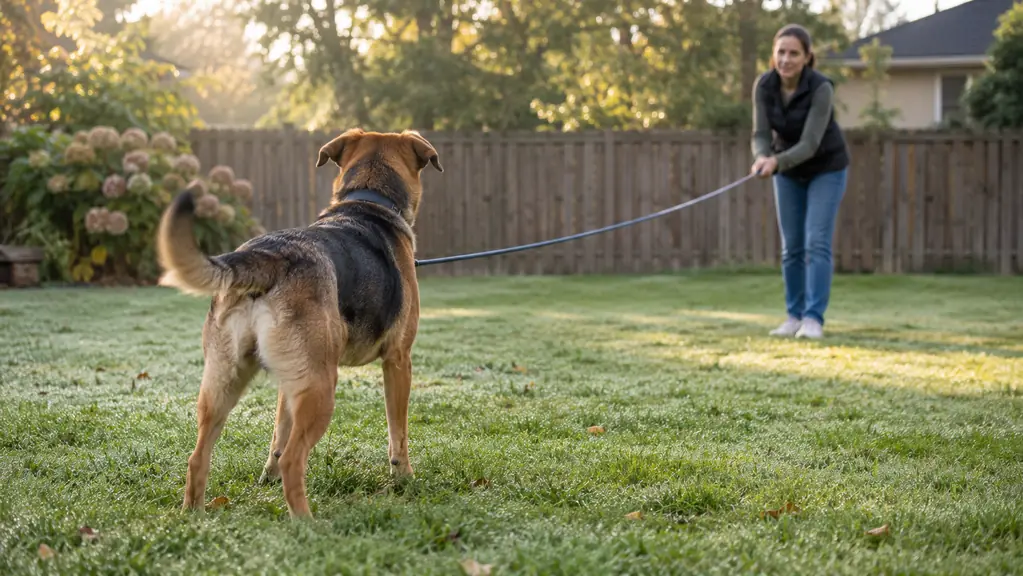
The first thing I noticed about the Hi Kiss long lead was not the leash. It was that I had spent four months trying to teach recall from the end of a six foot strap. Biscuit is a Labrador mix we adopted from the county shelter at age two. He is three now, about sixty five pounds, and when he came home he pulled like a freight train and treated his own name as a mild suggestion. I am sixty one, retired after twenty eight years walking a mail route here in Sedalia, Missouri. I thought I knew dogs. What I knew was how to walk past them without getting bitten. Training one is a different job entirely, and it took me a while to admit that.
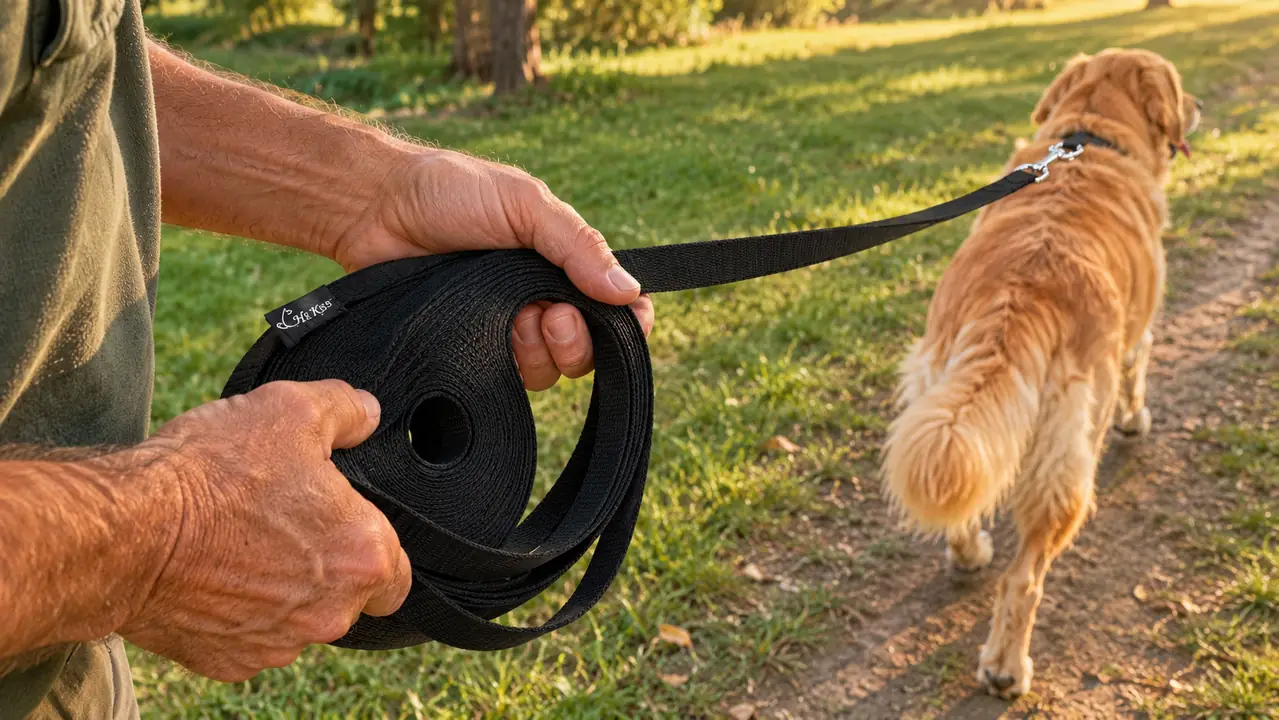
A neighbor at the city park handed me his Hi Kiss lead one Saturday morning and told me to give it a try. Fifteen feet of nylon, three quarters of an inch wide, a swivel snap on the end. That is the entire product. What surprised me was not that Biscuit behaved better that morning. It was that I finally had room to ask him for something and then reward him for doing it, instead of correcting him a half second after the fact. That gap, the one between the behavior and the reward, turned out to be the whole problem. Everything else I had been buying was decoration.
The Quick Verdict
A plain, honest training tool that does one job well: it gives you and your dog enough distance to practice recall properly. It will not train the dog for you, and on a hard puller in open ground it will sting your hands.
Amazon Check Today's Price →Fifteen feet of room, which is more than I had before
The Hi Kiss lead is fifteen feet of three quarter inch nylon with a swivel bolt snap and a snap closure. That is all it is. For Biscuit that was enough to make recall practice possible instead of theoretical.
Amazon Check Today's Price on Amazon →What the Hi Kiss Lead Actually Is
The listing is short and I appreciate that. The Hi Kiss training lead measures fifteen feet long and three quarters of an inch wide. It is nylon, the listing puts it at 1.76 ounces, and it closes with a snap. The snap is a swivel style bolt snap, which means it turns instead of fighting the line when the dog circles. There is no handle at the far end, no bungee section, no padding, and no reflective stitching on the one I have. It is a strap with a clip on it, and that is the honest description.
That sounds like faint praise. It is not. A long lead has one job, which is to be a reliable connection between your hand and your dog at a distance. Anything that complicates that is weight and hardware you have to manage with one hand while you are holding a treat pouch in the other. This one is light enough that Biscuit does not notice it dragging behind him, and light enough that I forget it is in my jacket pocket when I fold it up and head back inside. Simple is the feature here, whether or not the box says so.
How I've Used It With Biscuit
Our routine is three short sessions a day, five to ten minutes each, in the fenced backyard. I clip the lead to his collar, let out most of the line, and stand still. When he wanders toward me I mark it and pay him. When he ignores me I say nothing and wait. This is not glamorous work. It is standing in Missouri humidity with a pocket full of cut up hot dog, watching a dog make decisions at his own pace. Some sessions he is brilliant. Some sessions he is a Labrador mix with a squirrel situation.
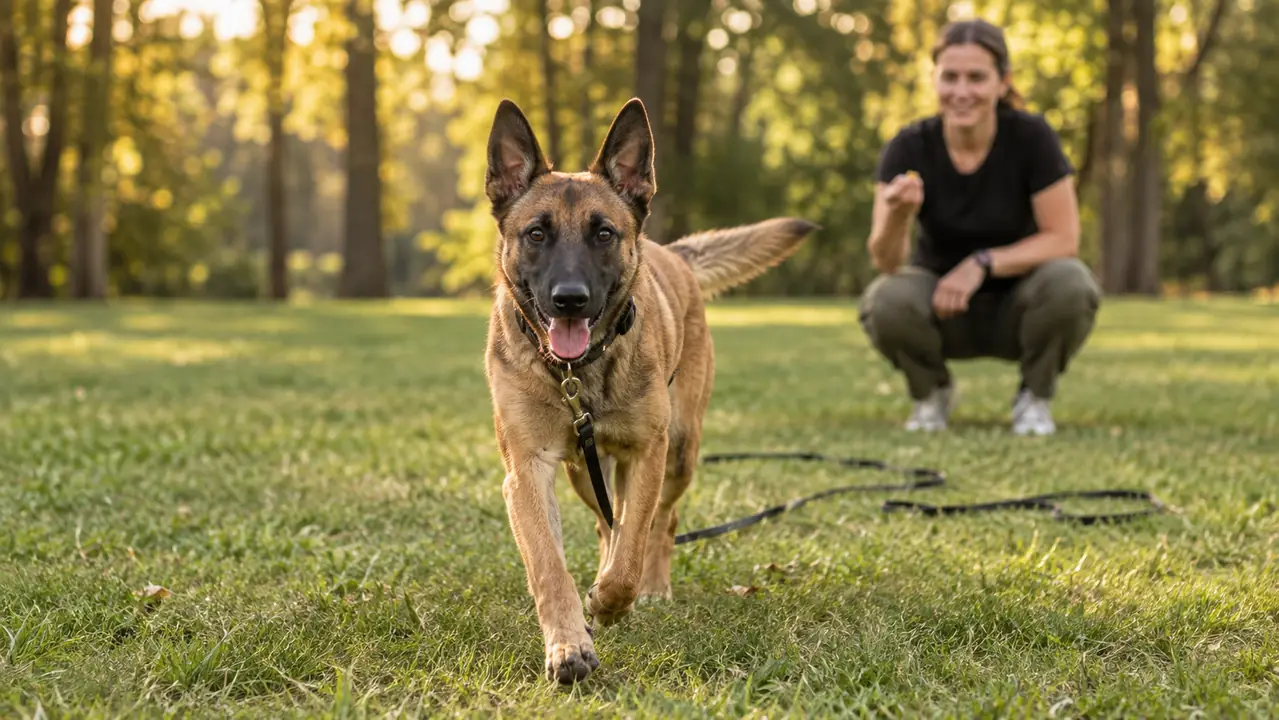
The weekend trips to the park are where the extra length earns its keep. On a six foot leash a recall gives the dog about one second of decision time before he is already at the end of the line. Fifteen feet gives him maybe three. That sounds trivial until you watch it happen in real time. Three seconds is enough for Biscuit to hear his name, think it over, and turn around under his own power. On the short leash he never got to make that choice, so he never learned to make it. He just learned that the line stops him.
We also use it for something I did not expect, which is polite greeting practice. I can stand on the far side of the yard with the line loose on the grass and let him drag it while he sniffs around, then call him in and reward the check in. The swivel bolt snap keeps the line from winding up tight against his neck when he spins. Small thing. You notice it around the third session, when you stop having to untwist the clip every time the dog turns around.
What the Long Line Won't Fix
It does not teach the dog anything by itself. I want to be plain about that, because the listing language about teaching recalls can read like the equipment does the work. It does not. What the line does is remove an obstacle, and the obstacle is that your dog is always within arm's reach and therefore never has to decide anything. The deciding is still on the dog. The paying is still on you. And the patience is still on you, which is the part I struggle with.
It also will not fix pulling on a normal walk. Those are separate skills that want separate equipment. If your dog drags you down the sidewalk, you need a front clip harness or a different walking setup entirely, and fifteen feet of line in the street is a hazard, not a solution. I made that mistake exactly once, on a quiet Sunday morning when I thought I would be clever. Biscuit and I both regretted it, and a man on a bicycle regretted it too.
What Nobody Tells You About a 15 Foot Lead
Nobody tells you that the first ten minutes with a long line are mostly about you, not the dog. Fifteen feet of three quarter inch nylon does not manage itself. Biscuit crossed over the line, looped it around a shrub, and wrapped a porch post inside the first quarter hour. I spent more time untangling than training. Then I learned to gather the slack hand over hand instead of letting it pool on the ground, and most of the problem went away. It is a skill you pick up in an afternoon, but you will pick it up the hard way.
Nobody tells you that a long lead on a grassy park is a burr magnet. Nylon picks up everything it touches. I keep a stiff brush in the truck now and give the line a quick pass before I coil it. Cotton might feel nicer in the hand, and the listing makes the case that nylon outlasts cotton, which matches what I have seen so far, because mine has not frayed at the snap after a season of being dragged across gravel and pavement.
And nobody tells you the obvious thing. Fifteen feet is a runway. Biscuit is sixty five pounds and he can build real speed in that distance. If he hits the end of the line at a full run, you feel it in your wrist and your shoulder. That is not a defect in the leash, that is physics. It is why I keep most of the line gathered in my hand in open ground and only let it run out when I am actively asking for a recall. On a thirty pound puppy you will barely notice. On a big dog, wear a glove the first few times until the two of you learn each other.
Four weeks of ten minute sessions on the Hi Kiss lead took Biscuit from coming back maybe three times out of ten to eight out of ten. Not perfect. Better. I will take better.
Why I Stopped Using the Retractable
I had one of those retractable handles for two years before this. It felt convenient, and for walking a dog who mostly minds, it probably is. What I did not understand is that a retractable keeps constant tension on the line, so the dog is always being pulled toward you at least a little bit. That is the opposite of what you want when you are teaching a dog to choose to come back to you. You want slack. Slack is the entire point, and a spring loaded handle cannot give it.
The Hi Kiss lead gives slack because it is a fixed length of nylon lying on the ground. Nothing is reeling it in. Biscuit can stand there with three feet of line pooled at his feet and think about whether he wants to come, and I am not accidentally nudging him with tension while he decides. That difference mattered more than any treat I tried in the first month. It also cost me far less frustration, because a fixed line cannot jam, ratchet, or snap back at my shins.
The Tradeoffs I Actually Hit
The biggest one is not about the leash at all. A long line is a training tool, not a walking tool. You cannot walk a dog around the block on fifteen feet of nylon and expect a pleasant stroll. It is for practice in a yard, a park, a quiet field, or a parking lot at six in the morning before anyone else shows up. When we walk the neighborhood, Biscuit is on a six foot lead, same as always. The long line lives in the truck and comes out when we are working. Two different jobs, two different pieces of gear.
The second is hand comfort. There is no padded handle, because there is no handle. You are holding folded nylon. With a dog that pulls, that is going to dig into your fingers. I wear a work glove on my right hand. June laughs at me from the porch, but June is not the one holding the line when a Labrador mix spots a squirrel and decides the squirrel is more interesting than obedience.
What I Liked
- Fifteen feet is enough distance for a dog to actually make a choice about coming back
- Light enough that the dog drags it without noticing, listed at 1.76 ounces
- Nylon has held up to grass, gravel, and a full season of being dragged
- The swivel bolt snap turns with the dog instead of twisting the line into knots
- Simple enough to fold and pocket, with no handle or bungee to manage while holding treats
Where It Falls Short
- No handle, so a hard puller will feel it in your hands and fingers
- Nylon picks up burrs and needs brushing off after a park session
- Fifteen feet of line tangles on shrubs, legs, and porch posts until you learn to gather it
- A running dog hits the end of the line hard, which is a real shoulder jolt at sixty five pounds
- Not a walking leash, you still need a short lead for the street
Who This Is For
This is for the person doing homework. If you have a puppy, a rescue, or an adult dog with no recall, and you are willing to stand in the yard for ten minutes a few times a day with food in your pocket, a long line is the most useful piece of gear you can add for the money. It is also for the person who has been told to practice recall and cannot see how, because their dog is already at the end of a six foot leash by the time the word leaves their mouth. That was me for four months, and I wish someone had handed me a line in week one.
Who Should Skip It
Skip it if your dog is reactive and you work anywhere near other dogs. Fifteen feet is a lot of line to reel in when another dog appears around a corner, and a tangle in a tense moment is the last thing you need. Skip it if you want to walk down the street hands free. Skip it if you are not going to train, because a long line on an untrained dog is just a longer way to get jerked off balance. And if your dog is a heavy, hard puller well over a hundred pounds, start with a shorter line and heavier hardware than this. The Hi Kiss lead is listed for medium dogs, and that listing is not being modest.
How It Has Held Up
One season of dragging through grass, gravel, one muddy April, and the bed of a pickup. The nylon has a couple of spots where it went fuzzy against concrete. The snap still works, the swivel still turns, and the stitching at the clip has not started to go. At under two ounces it is not a heavy piece of gear, so it is not going to fail from its own weight pulling on a seam. When long lines fail it is usually the snap or the stitching, and neither has given me trouble yet.
Storage matters more than I expected. I coil it and hang it on a nail in the garage instead of stuffing it into a bag. Looped loose it stays straight, and a straight line does not tangle the next time you let it out. Small habit. It saves five minutes of muttering in the yard every session.
How I'd Start If I Were You
Clip the line, let out about ten feet, and stand still. Do not call the dog over and over. Say the name once, wait, and pay the dog for any movement toward you, even a head turn. Keep sessions under ten minutes and quit while he is still having a good time. Do not use the long line to practice sit and stay at distance until the recall is reliable, because those are two different jobs and mixing them confuses everybody including me. Keep a short leash for the actual walk. The long line is for the yard. That is the whole method. It is not complicated, it is just repetitive, and repetitive is the part most of us quit on first.
If you are going to practice recall, give yourself the room to practice it
The Hi Kiss lead is fifteen feet of three quarter inch nylon with a swivel bolt snap and a snap closure. Nothing fancy about it. Just enough distance to let a dog choose, and enough slack for you to reward the choice before he changes his mind.
Amazon Check Today's Price on Amazon →