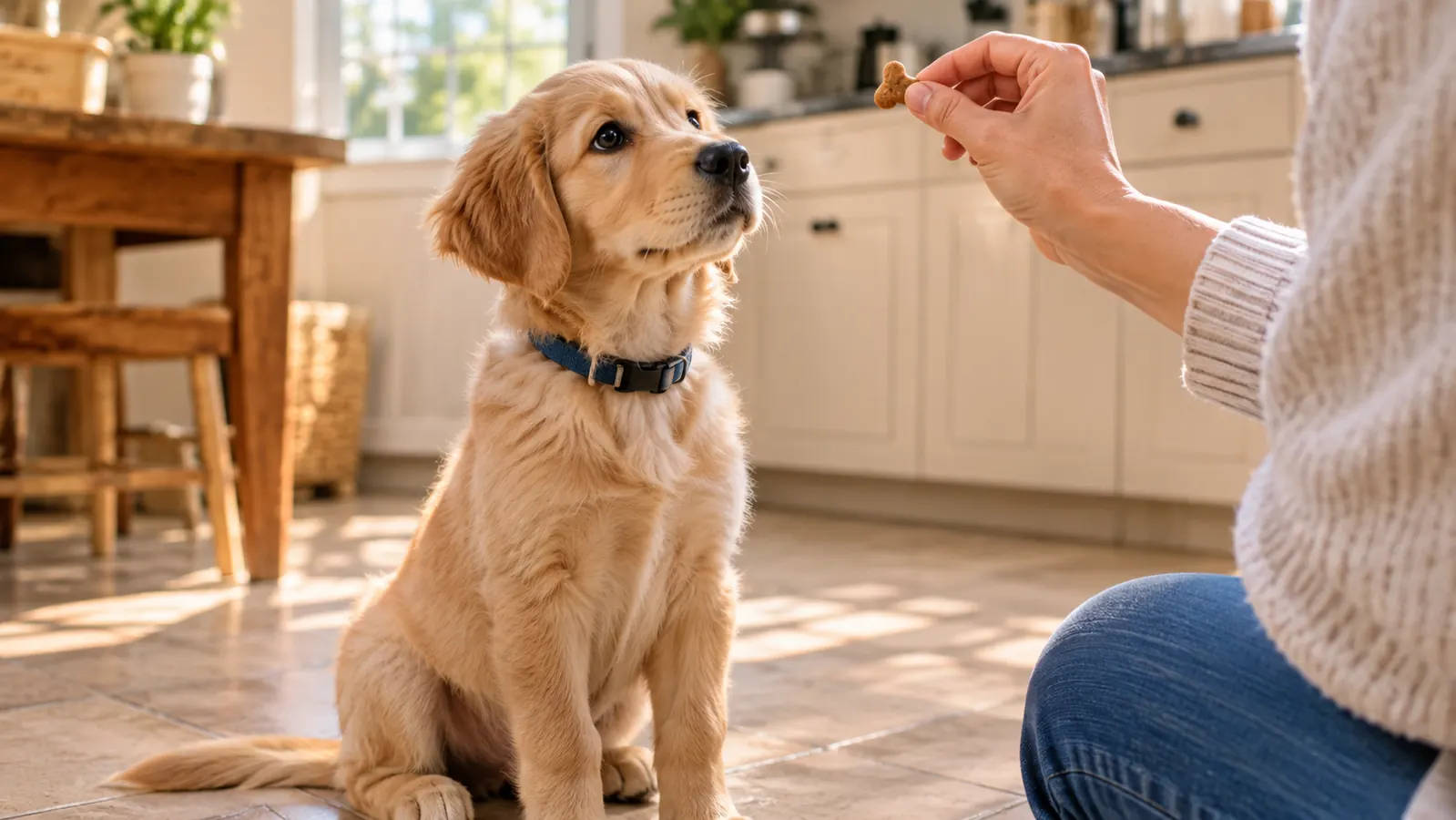
Here is the part nobody mentions before your first training session: the hard part is not teaching the sit. The hard part is getting a puppy to look at you for more than two seconds while the whole world is happening right behind you. A bird. A leaf. Another dog three houses down. A crumb on the kitchen floor. I have watched a puppy forget I existed halfway through a command, and I have watched a good treat bring him right back and hold him there. That second part is what this article is about. I am not a professional trainer. I am a retired mail carrier in Sedalia, Missouri, 28 years on a walking route, which means I met every kind of dog there is through a chain link fence before I ever tried to teach one anything. These days I train one rescue Lab mix named Biscuit at home, in short sessions, with treats and patience. Blue Buffalo Bits became my everyday training reward, and most of what follows is how I use them to keep a puppy's head in the game.
A puppy is not stubborn. He is not ignoring you on purpose. He is a small animal whose brain is being rebuilt every week, and his attention goes wherever the movement and the smell happen to be. You cannot out-command that. You can only out-bid it. Every session is a quiet negotiation, and your puppy is deciding moment by moment whether what you are offering is worth more than what the yard is offering. A dry, boring reward loses that negotiation every single time. That is why the treat in your pocket matters more than the command list you printed off the internet.
The reward has to beat the leaf on the sidewalk
Blue Buffalo Bits are soft, quick-to-chew training treats with real chicken as the first ingredient. Made without corn, wheat or soy, in a 19-oz bag that gets you through weeks of short daily sessions.
Amazon Check Today's Price on Amazon →Why Puppy Focus Breaks Down in the First Place
Puppies have roughly the attention span you would expect from a creature that has been alive for fourteen weeks. In my house that meant three good minutes in the kitchen and about forty seconds in the backyard. Nothing was wrong with the puppy. The setting had simply gotten more interesting than I was. Once I figured that out, I stopped blaming the dog and started looking at two things: how long I was asking, and what I was paying with.
The second thing is the one people skip. A puppy working for a piece of kibble he gets three times a day is not working for much. A puppy working for something soft, smelly and only available during training is working for a payday. Same dog, same commands, a completely different session. I learned that with Biscuit, who came home at two years old with the attention span of a puppy and the pulling power of a small tractor. When I switched him from his regular food to a dedicated training treat, the sessions got shorter and the progress got faster, which is the opposite of what I expected.
I timed it once out of plain curiosity, sitting on the back step with a stopwatch balanced on my knee. In the kitchen Biscuit gave me four minutes of real work before the floor sniffing started. Same dog, same commands, out in the backyard, and I got ninety seconds. That one number taught me more than any video I watched. I was not losing his attention. I was spending it, a little at a time, and never noticing the till was empty until he was already gone.
Step 1: Pick a Reward That Works in Under Two Seconds
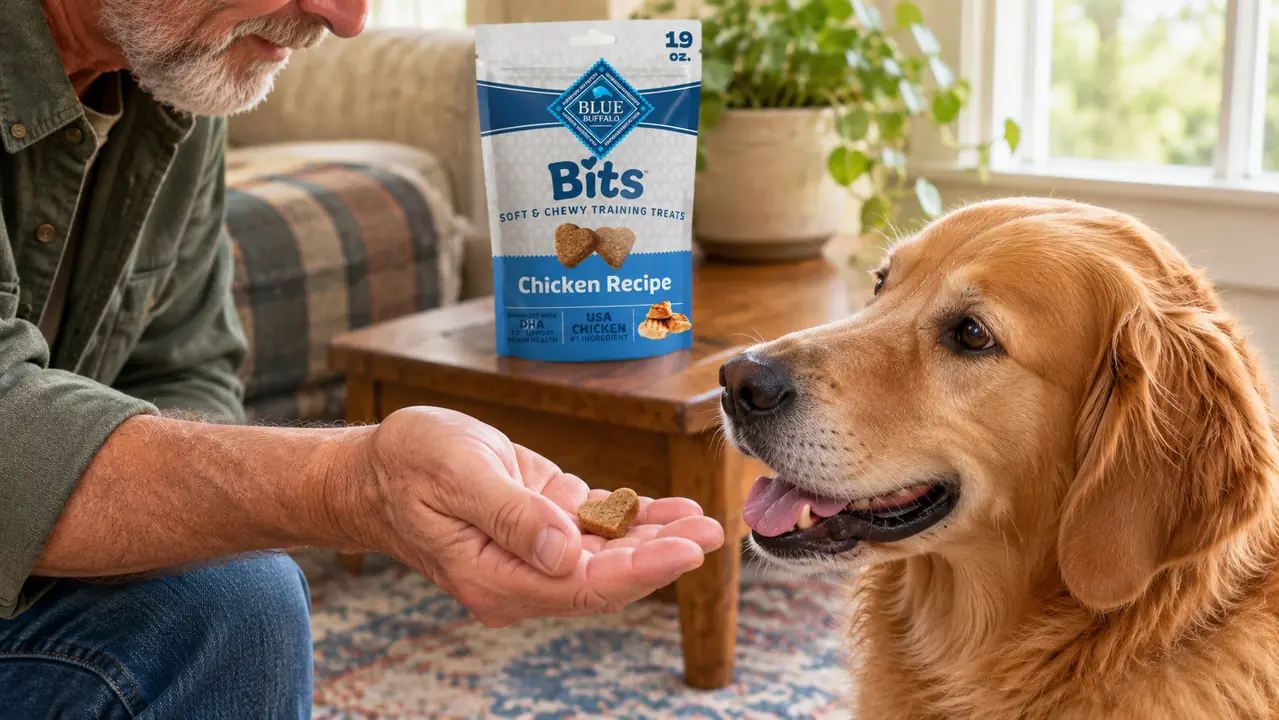
A training treat has one job: get from your hand into the puppy's mouth without ending the lesson. A hard, crunchy biscuit takes ten seconds of chewing, and by the time the puppy looks up he has forgotten what he did to earn it. A soft treat is gone in a couple of chews and the lesson keeps moving. That is the whole reason I landed on Blue Buffalo Bits. They are soft and moist, chicken is the first ingredient, and a 19-oz bag carries me through weeks of short sessions.
The ingredients matter for a practical reason, not a fancy one. These are made without corn, wheat or soy, which counts for something when you are about to hand a puppy twenty small rewards in five minutes. Nothing ends a training streak faster than a treat that does not agree with the dog. The listing also notes DHA, an Omega-3 fatty acid, plus Omega 3 and 6 from flaxseed, which the maker ties to cognitive development and coat condition. I am not a vet and I will not pretend a treat is medicine. I am saying that if I am handing out twenty rewards a session, I want them to be more than filler.
One practical note: tear them in half for a very young puppy or a gulper. I keep a handful in my jacket pocket, and by the end of a session they are warm and smell like chicken, which is a feature, not a bug. Biscuit can hear that pocket open from the next room.
Step 2: Cut the Session Down to What the Puppy Can Actually Handle
Five minutes. That is the ceiling for a young puppy, and honestly three is better. I run two or three sessions a day and I stop while the puppy still wants more. Stopping early feels wrong, like leaving food on the plate, but it is the single best thing I do for focus. A puppy who ends on a win remembers training as the good part of the day.
Watch for the signs that the tank is empty: the head swings away, the sits get slower, the puppy starts sniffing the floor or chewing at the leash. That is not defiance, that is a tired brain. Put the treats away and go inside. You will get more done in three five-minute sessions than in one twenty-minute grind, and you will both be in a better mood for the next one.
I did it wrong for a solid month first. My sessions ran twelve, fifteen minutes, and I told myself the extra time was building endurance. What it actually built was a dog who started drifting toward the back door the moment I reached for the treat bag. I cut the sessions to five minutes, then to three, and the drifting stopped inside a week. Three weeks after that, Biscuit was waiting at the door for me instead of hiding from me.
Keep a count if you are the kind of person who likes numbers. I aim for ten to fifteen rewards in a session and I quit on a good one. With a bag of Blue Buffalo Bits in the cupboard, that math works out to weeks of daily work, which is the pace a puppy actually learns at.
Step 3: Pay the Behavior, Not the Begging
Timing is the whole game, and it is the thing most of us get wrong. The reward has to land within a second or two of the behavior, or the puppy thinks you are paying for whatever he happens to be doing when the treat arrives. If he sits, then stands up, then gets the treat, you just paid for standing.
Use a marker word. I use yes. Say it the instant the puppy does the thing, then get the treat into him. The word bridges the gap while your hand travels to the pocket. Do it the same way every time and the puppy starts listening for the word, which is the beginning of focus.
Deliver the treat where you want the puppy to be. For a sit, that means at your knee, not out in front of you where he has to get up to reach it. I learned that one the hard way with Biscuit, who spent a solid month offering me a perfect sit two feet too far away because that is where my hand kept going.
Here is what paying for the wrong thing looks like in a real living room. I asked Biscuit for a down on the rug, he dropped, then popped back up before my hand cleared my pocket, and I rewarded him anyway because I was glad he had done it at all. Two days later I had a dog who would not hold a down for longer than a second. I spent the next week resetting it, marking the down the instant his elbows touched the rug instead of the instant I felt proud of him.
Step 4: Train the Environment Before You Train the Puppy
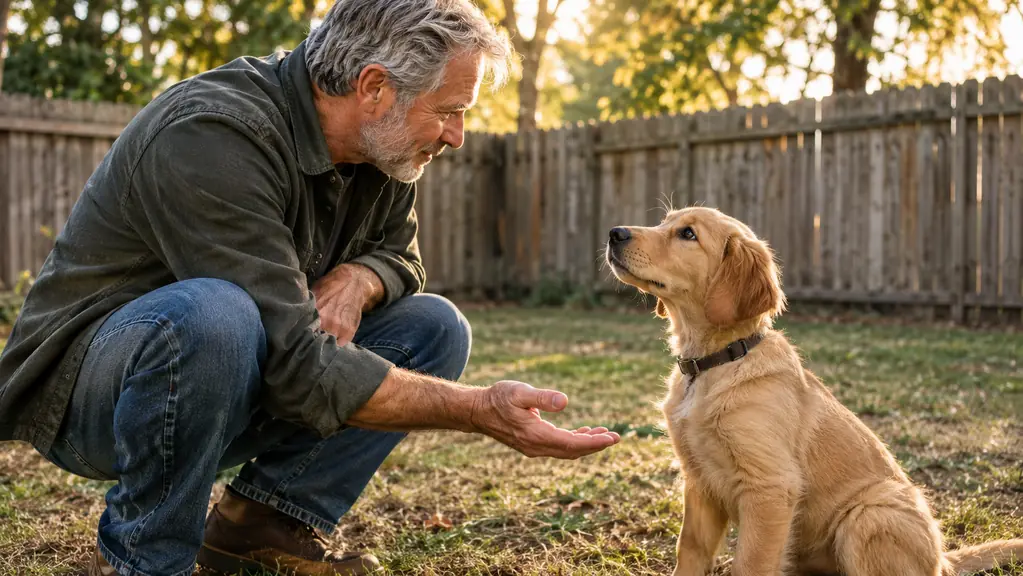
A puppy cannot learn focus in a quiet room and then magically keep it at the park. You build it in layers. Start in the quietest room in the house, then the kitchen, then the backyard, then the front yard, then a quiet sidewalk. Each time you move up a level, expect the puppy to act like he has never heard the word sit in his life. That is normal and it is not a step backward.
Blue Buffalo Bits earn their keep right here. When I raise the difficulty, I raise the pay. In the kitchen a single treat is plenty. Out front, where the neighbor's dog is barking through the fence, I pay twice as often and I keep the session even shorter.
If your puppy cannot focus at a new level, you went too far too fast. Back up one step and stay there a few days. There is no prize for rushing, and the dog does not care about your schedule. My own ladder went kitchen, back porch, front walk, then the sidewalk by the mailbox. I stayed on the porch for six straight days because Biscuit could not hold a sit out there without breaking away to smell the grill next door. Six days felt like forever at the time. Looking back, it was the fastest progress I made all spring.
Step 5: Build a Name That Means Look At Me
This is the one drill I would keep if I could only keep one. Say the puppy's name once, and the instant his eyes meet yours, mark it and pay. Do not repeat the name. Do not stack a command on top of it. The name means look at me, and looking at you is the door everything else walks through.
Do it ten times in a quiet room with a treat in your hand. Then do it in the backyard. Then on a walk, standing still. In a few weeks you will have a puppy who checks in with you without being asked, which is the closest thing to a trained dog that most of us actually need. Keep the sessions boring and short and let the repetitions pile up. Ten boring reps a day beats one heroic Saturday afternoon every time.
Keep the name clean. If you holler it every time he is in trouble, it stops being a payday and becomes a warning. Biscuit's name means something good is about to happen, and that is why he turns around at the park when I say it.
What Else Helps
Feed the puppy before training, not after. A hungry puppy works harder, but a starving one cannot think straight. I split Biscuit's breakfast and use a few pieces of it as a warm-up before the real training treats come out.
One group obedience class was worth more to me than a stack of videos, mostly because it put Biscuit in a room with other dogs and made focus a skill he had to practice instead of a skill I talked about. You do not need a private trainer to get that. Six other handlers and a folding chair was plenty.
Keep a note on the fridge. Three lines: what you worked on, how long it ran, and how it went. In a month you will see progress you cannot feel day to day, and on the bad days that note is the thing that keeps you going out to the yard.
Four seconds of eye contact in a quiet kitchen turned into twelve seconds in the backyard, and that took three weeks of five-minute sessions and a pocket full of soft treats.
Start with a reward worth looking up for
One 19-oz bag of Blue Buffalo Bits gets you through weeks of short daily sessions. Real chicken first, soft and quick to eat, so the lesson keeps moving instead of stalling out on a chewy biscuit.
Amazon See Blue Buffalo Bits on Amazon →