
The first night with a puppy in the house teaches you two things fast. Puppies do not arrive with a schedule, and your carpet did not sign up for this. By the third night you learn a third thing, which is that nobody sleeps well when you are up every ninety minutes listening for a whine at the door.
I am not a trainer and I will not pretend to be one. I carried mail on a walking route in Sedalia, Missouri for 28 years, so I have met every kind of dog there is through a screen door, and I have made most of the beginner mistakes myself. When we brought Biscuit home from the county shelter at age two, he had never lived indoors and had no idea what a door was for.
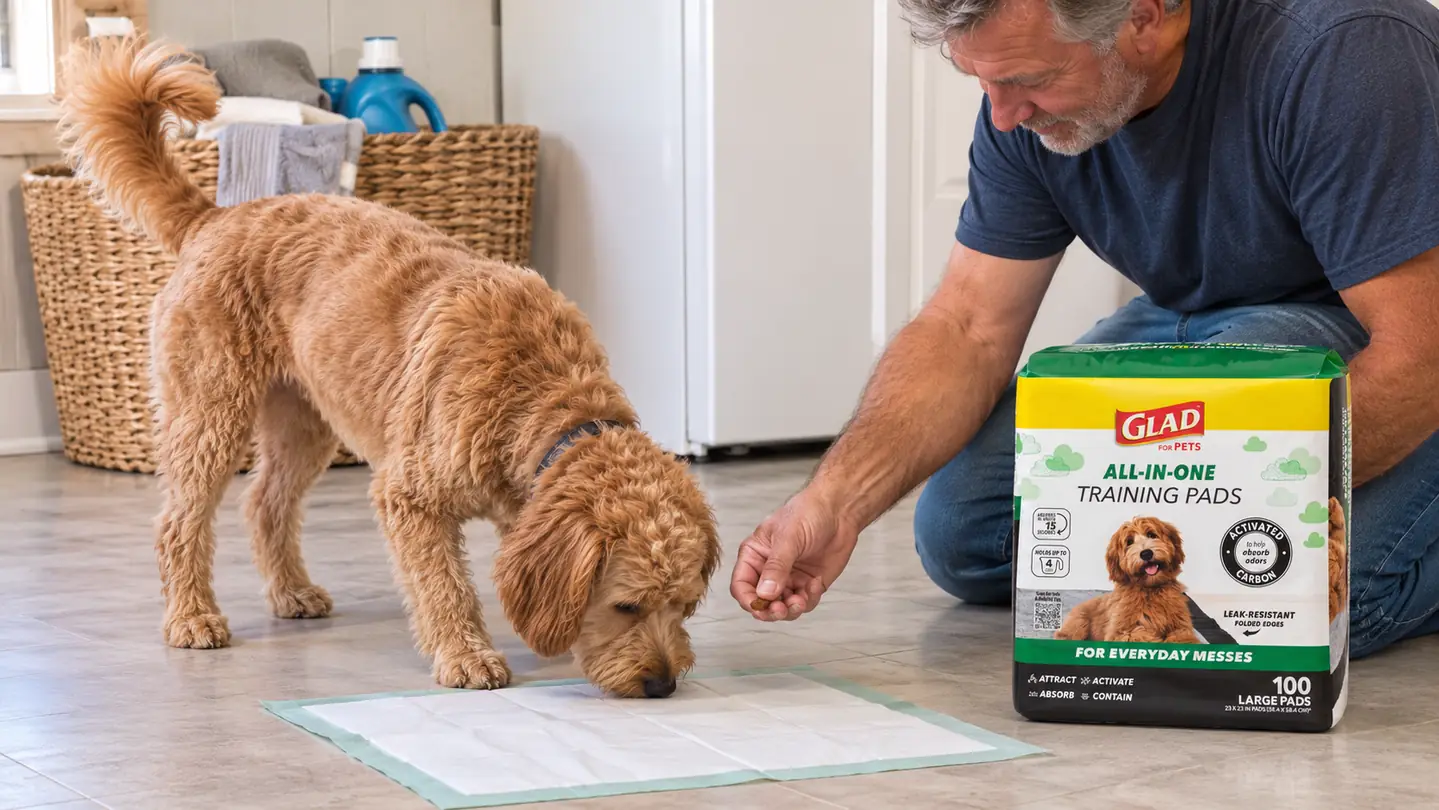
Here is the part I wish somebody had said to me plainly, and it is the reason there is a box of Glad for Pets Puppy Pads in my hall closet. A pad is not a failure and it is not a shortcut. It is a floor you can pick up and carry to the trash. For a puppy with a bladder the size of a walnut, or a rescue dog who has never lived indoors, a pad keeps the training moving at two in the morning when the backyard is dark and forty degrees and you are in your robe. The ones I keep are the activated carbon pads in the 100 count box. Each one measures 23 by 23 inches and is rated to hold up to 4 cups.
The Floor You Can Fold Up and Carry Out
Glad for Pets Puppy Pads, 100 count, 23 by 23 inches. Six layers, leak-resistant folded edges, and a polymer core that turns liquid into gel so cleanup is one motion instead of a scrub bucket and a prayer.
Amazon Check Today's Price on Amazon →Step 1: Choose the Potty Spot Before the Puppy Comes Home
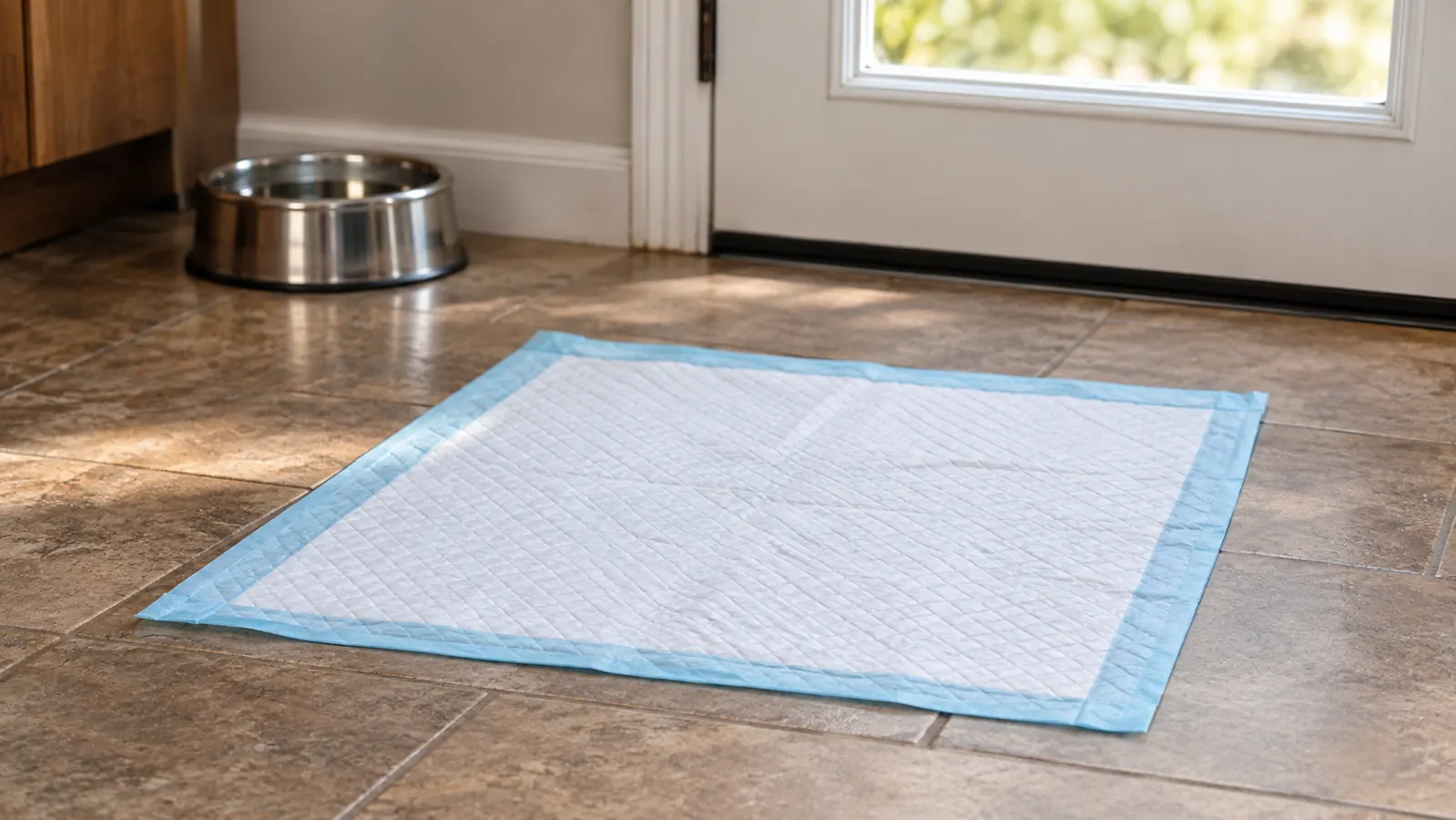
Pick the spot before you pick up the puppy. Stand in your kitchen, find the shortest path to the back door, and put the pad at the end of that path. You are not decorating. You are building a habit that has to survive at 5:30 in the morning when you are barefoot, half awake, and not inclined to make good decisions. The closer the pad sits to the door you will eventually use, the less distance you have to move it later.
A good spot is a hard floor, close to the door, out of the traffic lane between the kitchen and the living room, and not within sniffing distance of the food bowl or the bed. A bad spot is carpet, the middle of the hallway, or the corner where the vacuum lives. A puppy will not use a pad in a place that startles him, and a spot you have to step over forty times a day is a spot that gets moved, and a moved spot is a restarted lesson.
Lay one pad down flat. The 23 by 23 inch size gives a small puppy room to circle twice and settle, which is what they do before they go. The folded edges on the Glad for Pets pads stand up enough to hold a puddle in place while you cross the room. Set a jar of small treats and a bottle of enzyme cleaner within arm's reach of that spot, because in the first two weeks you will be standing there more than you stand anywhere else in the house.
Step 2: Run a Schedule, Not a Guess
Puppies run on a clock you cannot see, so build one you can. Take the puppy to the pad first thing in the morning, after every meal, after every nap, after every play session, and right before bed. A young puppy who is awake and moving usually needs to go every hour or two. An older rescue dog can stretch that to two or three hours at the start, but not much more, and not on the first week.
Take him there. Do not point at the pad from the recliner and hope for the best. Carry a young puppy, or walk him on a leash, and set him down on the pad. Then stand still and be boring. No play, no high voice, no petting, no conversation. Give it five minutes. If nothing happens, put him in his crate or pen for ten minutes and try again. Boring is the point. The pad is where business happens, not where fun happens, and a puppy sorts that out faster than most people expect.
June put our schedule on an index card and stuck it to the refrigerator with a magnet. That sounds like a small thing until the fourth night, when neither of us could remember whether the last trip to the pad was before or after supper. Write it down and put it where the whole household can see it. Two people guessing at two different schedules is one puppy learning nothing, and it is the most common way indoor training stalls out.
Step 3: Learn the Two-Second Warning
You will hear people say a puppy gives no warning. That is not true. He gives a warning, it is just short. The signs are a sudden stop in the middle of play, a nose down and working the floor, circling, a slow walk toward a curtain or a corner, or a long sniff followed by a turn. Once you have seen it three or four times you will start catching it from across the room.
When you see it, do not yell. Move. Scoop him up if he is small enough, or take his collar gently and walk him over, and set him on the pad. Then wait, and let him finish there. If he does, reward him like he just brought home a paycheck, because from his side of things that is roughly what happened.
The mistakes you will make here are the loud ones. Chasing a puppy who is mid-puddle, saying no in a big voice, or pushing his nose at the spot. None of that teaches him where to go. It teaches him to hide it from you, which is worse, and it can take months to undo. I know because I did the loud version with a dog years before Biscuit, and that dog took a good while longer than he needed to. A puppy who is afraid of you is a puppy who goes behind the couch.
Step 4: Reward Fast, Clean Quiet
Reward within a second or two of the puppy finishing on the pad. Not when he walks back to you. Right there, on the spot, while he is still standing on it. A small treat delivered at the edge of the pad plus quiet praise is the whole lesson. The timing is the lesson. A treat that shows up eight seconds late teaches him that coming to you is the trick, which is not the trick you are trying to teach.
Accidents will happen, and how you clean them matters more than how you feel about them. Use an enzyme cleaner. Not ammonia, and not a vinegar soak. Ammonia smells like urine to a dog, and a spot that still smells like a bathroom is a spot he will use again. Blot it up, treat it, walk away. No lecture. He cannot connect a scolding to something he did four minutes ago, and the scolding only makes you feel better.
Changing a used pad is the part that decides whether you keep using them at all. The polymer core in the Glad for Pets pads turns the liquid into gel, so the pad is not a sloshing tray by the time you get to it. Roll it from the corners inward and it leaves the room in one piece. The carbon tissue layer pulls the smell down, which matters more than people admit in a bathroom, a laundry room, or a small apartment. The box says these stay fresh and dry about twice as long as standard pads, and for one small dog I have found that roughly right, which means fewer changes in a week and a trash can that does not announce itself.
Roll the pad from the corners inward and the whole mess leaves the room in one piece. That is the part that sold me, not the training theory.
Step 5: Walk the Pad to the Door, Then Shrink the Target
Once the puppy is hitting the pad most days, move the pad about a foot a day toward the door. Same pad, same room, just closer to outside. Dogs follow the surface, not the address, and most puppies barely notice a slow drift. If he starts missing, stop moving it for three or four days and let him catch up. There is no prize for speed here.
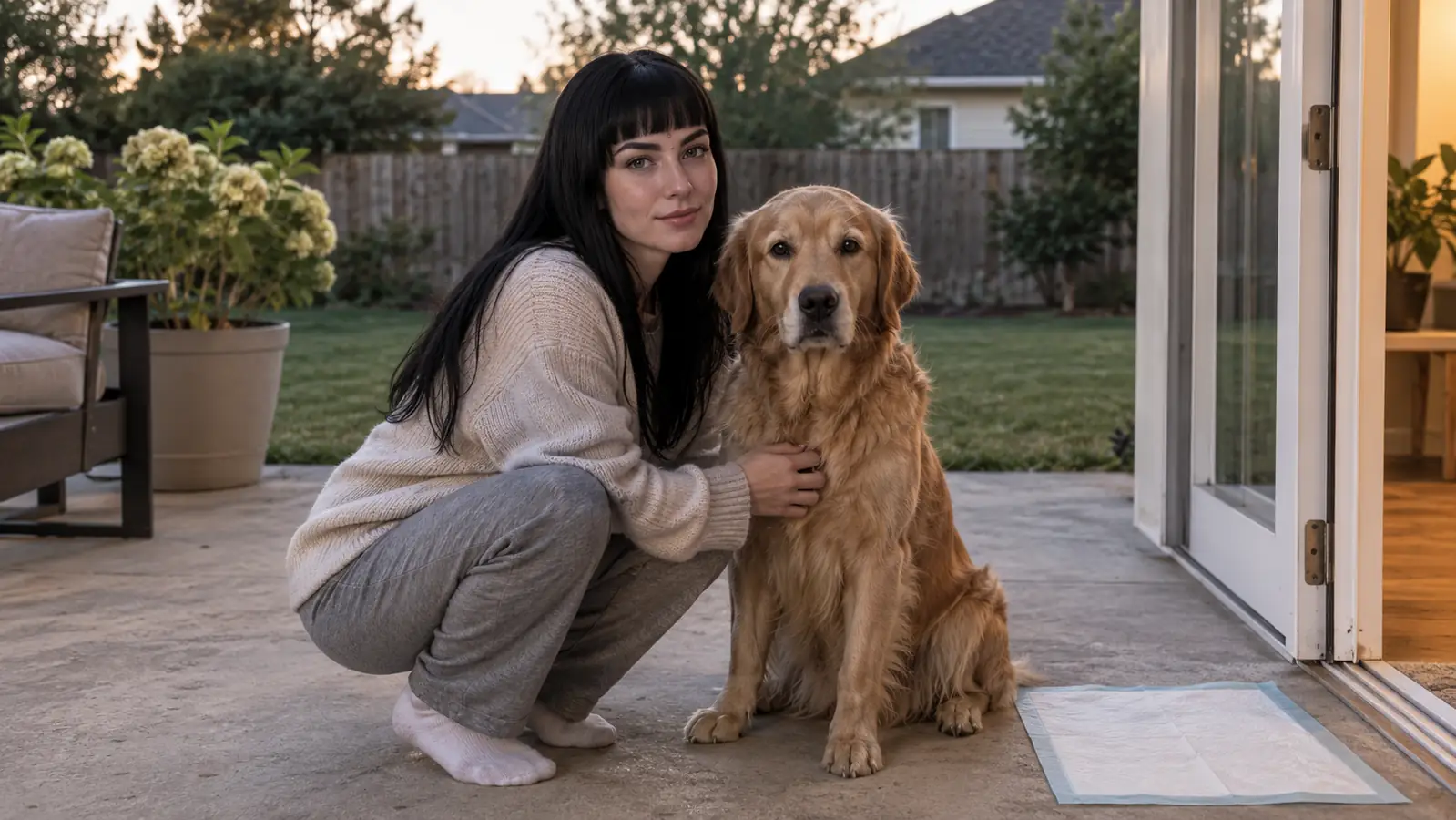
When the pad sits beside the door, put the next one just outside on the porch or patio. Go out with him. Stand there in the cold and be boring again. Reward out there the same way you did inside, same treat, same quiet voice. Then move the pad off the porch and onto the grass, a few feet further each time, until the pad is a backup instead of a destination.
Do not cut a pad in half to shrink the target. The polymer inside will spill out and you will be sweeping gel off the porch for a week. If you want a smaller target, use the pad whole and put it where you want him to go. Keep one pad by the door anyway, for rain, for late nights, and for the first month after you think you are finished, because that is usually when a puppy reminds you that he is still a puppy and you are still in charge of the schedule.
What Else Helps
A crate or a small pen earns its keep in this routine. Not as punishment, and not for eight hours at a stretch, but as a place where a puppy who just visited the pad can be parked for twenty minutes while you eat supper. Dogs do not like to soil where they sleep, so a properly sized crate does half the scheduling work for you. Too big a crate defeats the purpose. He should be able to stand, turn around, and lie down, and not much more.
Feed on a schedule, not from a bowl left down all day. What goes in on a clock comes out on a clock, and within a week you will start to see the pattern and know when to be standing near the pad. Pick up the water bowl an hour before bed once the puppy is old enough to handle it, and take him to the pad one last time right before you turn in. That single trip is the difference between a full night and a two o'clock cleanup.
Close doors. A puppy with the run of the house will find the one room you forgot about, and it will be the one with carpet. Keep him in the same room as you or in his pen, and hand him more space as the weeks add up. Everybody in the house has to use the same spot and the same word, whether that word is potty, outside, or something sillier that a grandkid came up with. Consistency from the humans is worth more than any piece of equipment you can buy.
If a dog who was doing fine suddenly starts missing the pad, call the vet before you call it a behavior problem. Urinary tract infections and a handful of other medical issues show up as accidents first, and a fifteen minute appointment can save you a month of guessing and blaming yourself.
Last thing, and I mean it. This takes weeks, not days. A puppy's bladder is still growing and his brain is still working out what you want from him. Progress is what you are after, not perfection. Some weeks you will go backward in the morning and forward again in the afternoon, and that is not a sign that you are doing it wrong. It is a sign that you are training a puppy.
Start With a Pad That Holds Up to the Whole Job
Glad for Pets Puppy Pads, 100 count, 23 by 23 inches, rated to hold up to 4 cups, with a polymer core that gels liquid and folded edges that keep it where you put it. Fewer changes, less smell, one clean fold at the end.
Amazon Check Today's Price on Amazon →