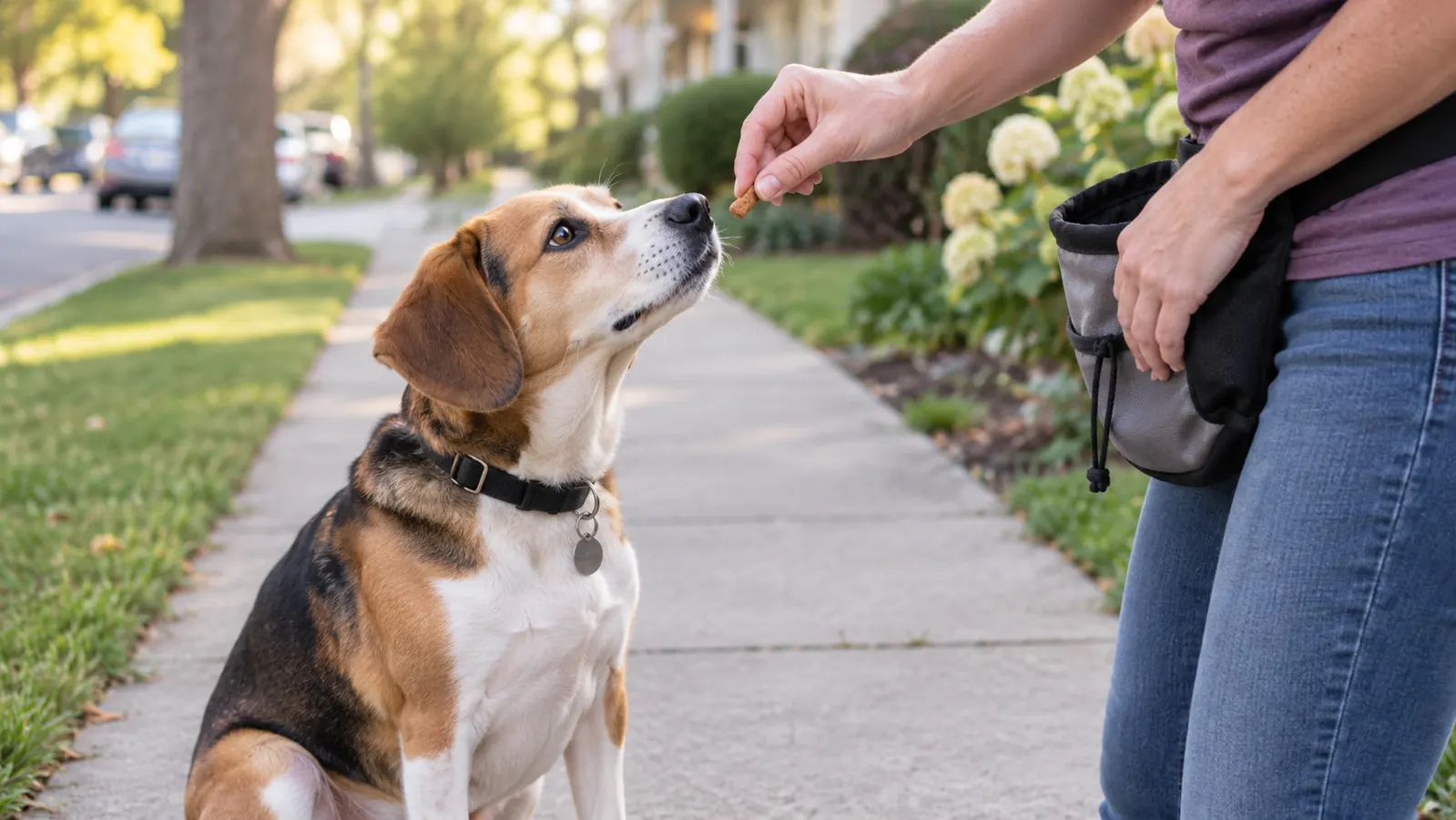
For the first month I had Biscuit, I was paying him for the wrong thing. He would sit at the curb like a gentleman, I would tell him he was a good boy, and then I would spend four seconds digging a piece of kibble out of my jacket pocket. By the time the food reached his nose he was already up and leaning into the leash. I blamed the dog. June blamed me, and June was right. The sit I thought I was rewarding had ended long before the treat arrived, so what Biscuit actually learned on that corner was that standing up and pulling is what pays. What finally fixed it was not a better dog or a firmer voice. It was the LANNEY treat pouch on my hip and a hard look at my own slow hands.
That is a timing problem, and it is the most common one I see when neighbors ask me why their dog will not listen. The dog is not stubborn and he is not stupid. He is being paid for whatever he happens to be doing at the exact moment the food appears. A treat pouch does not fix your timing all by itself, but it removes the fumbling, and for me the fumbling was most of the problem. Once the food sits two inches from my fingers instead of buried in a coat pocket, I can pay the behavior I actually want. I use the LANNEY dog treat pouch for this, and my reason is boring: I can work the opening with one hand while the other one holds a leash.
The treat has to arrive while the dog is still doing the thing.
The LANNEY treat pouch keeps a session's worth of kibble open at your hip, so the reward lands inside the one second your dog is still sitting. 4.7 stars from 5,027 ratings.
Amazon Check Today's Price on Amazon →Step 1: Find your one-second window
A reward has to land while the dog still connects it to what he just did. For a sit, that window is short. Biscuit could hold a sit for about a second and a half before his rear end came off the pavement, which gave me roughly one second to get food to his nose. Anything after that is not a reward for sitting. It is a reward for getting up, and a dog who gets paid for getting up will get up faster every time.
You find your window by watching the end of the behavior instead of the middle of it. Say the cue once, watch for the moment the behavior is finished, and count the seconds until the food arrives. Most people I know are two to four seconds late, and they are late because they are searching a pocket or a coat or a plastic bag in the other hand. The dog has already moved on by then, and he is being paid for whatever he moved on to. You do not need a stopwatch. You need to notice.
I tested this on June, who is not a trainer and did not particularly want to hear it. She would say sit, Biscuit would sit, she would say good boy, and then she would reach into her coat. I counted out loud. Four seconds. I asked her what he was doing at the four second mark. She said he was standing up and wagging. There it is. She was paying him for standing and wagging, and then wondering why he would not hold a sit on the sidewalk.
Step 2: Load the pouch and put it where your hand already goes
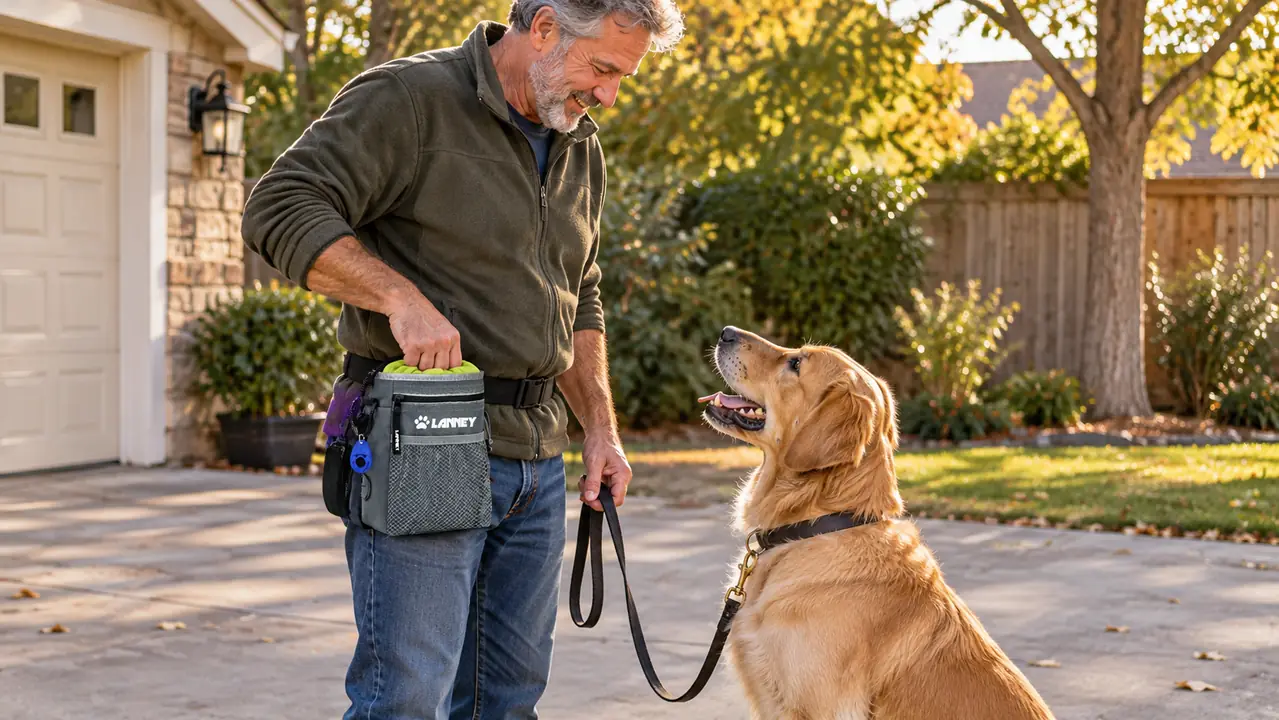
The LANNEY pouch measures 7.5 by 7.5 by 1 inches and weighs 8.1 ounces empty, light enough that I forget it is on until I need it. The outer is 600D oxford cloth with a PVC coating, which means kibble dust wipes off instead of grinding into the seams. The part that changed my training is the mouth. You press the cord lock and pull, and it opens wide enough to get a hand inside without looking down at it, which is the whole game when a dog is waiting on you.
I wear mine on the waist belt at the front of my left hip, roughly where my hand swings when I walk. Placement matters more than people think. If the pouch sits behind you or on the wrong side, your hand travels farther, your eyes drop to find it, and your timing gets worse before you have even started. The belt is adjustable and mine stayed where I put it through a two mile walk with a dog who still pulls through the first half of it. On days when I am not wearing a belt, the pouch moves to the shoulder strap.
Fill it before you leave the house, not in the driveway with the dog bouncing at the end of the leash and a neighbor waiting to tell you about his knee surgery. I fill mine at the kitchen counter, and I keep a small jar of kibble by the back door for refills. If you are training in the living room, the pouch goes on anyway. Half of good timing is simply having the food already on your body instead of sitting in a bowl in the kitchen while the moment passes.
Step 3: Mark the instant with a click, then pay
A clicker does one job. It marks the exact moment the dog did the thing, and it buys you the second you need to get the treat out of the pouch. The pouch comes with one and it is loud, which I did not appreciate at first. Biscuit's first click sent him about a foot backward and he looked at me like I had insulted his mother. I put the clicker in my pocket and muffled it for a week, clicking softly while feeding him, and by the second week he was leaning toward the sound instead of away from it.
Think of the click as a camera shutter and not a command. The click says that, right there, that exact thing, and then the food arrives. Once a dog understands the click, the gap between click and treat can stretch a second or two, because the click is what marks the moment. That is the entire reason the tool exists. My hands are not fast at 61 and they were never going to be. The clicker is faster than I am, and it is more consistent than I am on a wet Tuesday morning.
If the noise bothers your dog, or bothers you, use a word instead. I used yes, said flat, the same way every single time. The rule is one marker, used by everybody in the house, every time, without exception. June kept saying good boy in a soft voice about three seconds late, which is a kind thing to say to a dog and completely useless as a marker. We had to have a short conversation about it. She now says yes, and she says it on time.
Step 4: Deliver the treat where you want the dog, not where he is
Timing gets the food to the dog at the right moment. Placement gets the dog to the right spot. Both matter, and the pouch helps with both because it lets you do repeats quickly. For the curb sit, I put the treat right at his mouth while his rear is still down on the pavement. If I hand it to him up high, he stands up to take it, and I have just paid for standing. Small detail, large consequence.
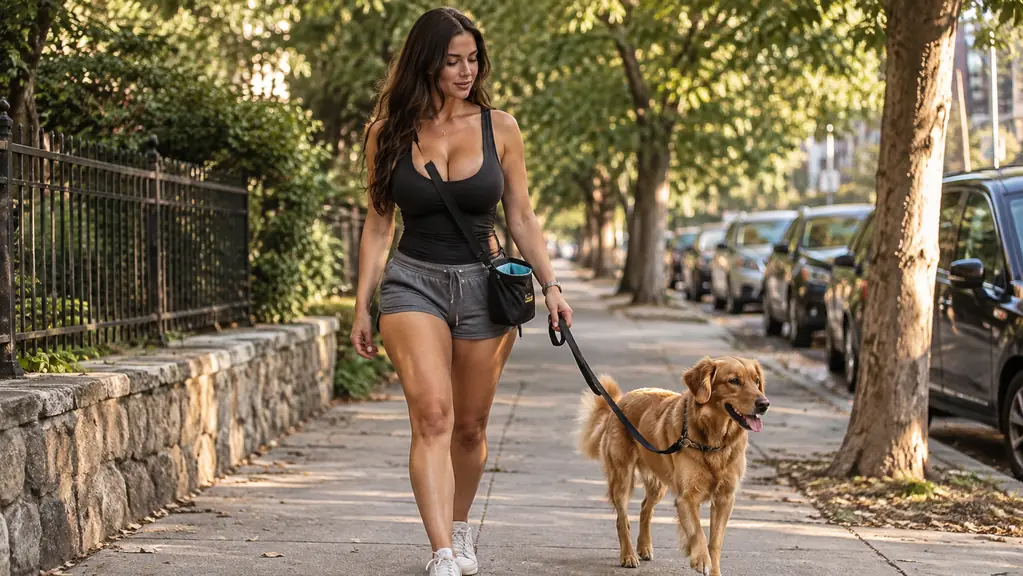
For loose leash walking, I drop the treat at my left knee instead of holding it out in front of me like a fishing lure. He swings back to my knee to get it, and then we are walking in the position I want instead of him dragging me toward my hand. The pouch hangs at that same knee, so the whole motion is short and repeatable. Short and repeatable is what makes a habit, for the dog and for the man holding the leash.
Small pieces, rapid repeats. I cut kibble in half and do five rewards in five seconds when he is getting something right. That is close to impossible with a coat pocket. It is easy with a pouch that stays open while you work. And do not hold the pouch out in front of his nose like a carrot on a stick. Keep it at your hip and let him work for the reward. A dog following a bag around the yard is not a trained dog. He is a dog following a bag.
Step 5: Keep sessions short and stack the odds before you make it harder
Two or three minutes, three times a day, is plenty for a dog like Biscuit. I end every session while he is still getting it right, not after he has lost interest and wandered off to inspect something in the grass. A short session with good timing beats a long one where you get sloppy at the end, and you will get sloppy, because everybody does. The dog remembers the sloppy reps too.
Start where the dog cannot fail and move one step at a time. Kitchen first, with nobody else in the room and the television off. Then the front yard. Then the sidewalk in front of the house. Then the walk to the park, which for us is about six blocks of squirrels, strollers and one particular golden retriever who has no manners. I add the next step only when he is getting it right most of the time at the current one. Counting out of ten is the easiest way I know to keep myself honest about that.
Biscuit went from about three out of ten on the curb sit to eight out of ten over roughly six weeks of this. At the city park with another dog coming toward us, he is still closer to three out of ten on a bad day, and I am not going to pretend otherwise. The pouch did not fix him, and anybody who promises you a fixed dog is selling something other than training. What changed is that he now gets paid for the right thing often enough that he offers it more, and that is the whole of it.
Eight out of ten at the curb, up from three out of ten, and the only thing I changed was when the treat arrived.
What Else Helps
The pouch solves a few small problems I did not know I had until they were gone. There is an enlarged zippered pocket on the front that fits most phones, and a zippered pouch on the back for keys and a card. There are two waste bag dispensers on the sides, so I am no longer the man on the corner asking strangers for a bag. Everything I need for a walk rides on my waist, and I have stopped patting my pockets every thirty seconds like I am checking for my wallet.
The shoulder strap matters more than it sounds. In summer I am usually in shorts with no belt, and a waist belt has nothing to hold on to. The strap is adjustable and the pouch sits at my hip either way, which keeps my hand traveling the same short distance no matter what I am wearing. The listing calls it three ways to wear. The two I actually use are the waist belt and the shoulder strap, and both do the job.
About the size, since people ask. It is a medium pouch, 7.5 inches square, big enough to get a hand into without looking and small enough that it does not swing around when you jog a few steps to catch a dog who has spotted something. It is not a bait bag for a professional trainer hauling a week of food for six dogs. It is a pouch for one walk and one session, refilled from a jar by the door. That is exactly the amount of gear I want at my age with a dog who still has opinions about squirrels.
Housekeeping is simple. The PVC coating means you can wipe the inside out with a damp cloth, and you should, because warm kibble left in a closed pouch for a week smells like a decision you regret. I rinse mine on Sunday and let it dry open on the porch rail. I also keep the clicker on the same strap as the pouch, so the two things are never separated, and I stop the session the moment I notice I am getting frustrated with the dog, because a frustrated handler has terrible timing and the dog can hear it in your voice.
Your dog learns from the second the food lands, not from the second you meant well.
Adjustable waist belt, shoulder strap, cord lock opening, clicker included. The LANNEY treat pouch keeps the reward within reach so your timing stops being the weak link.
Amazon Check Today's Price on Amazon →