
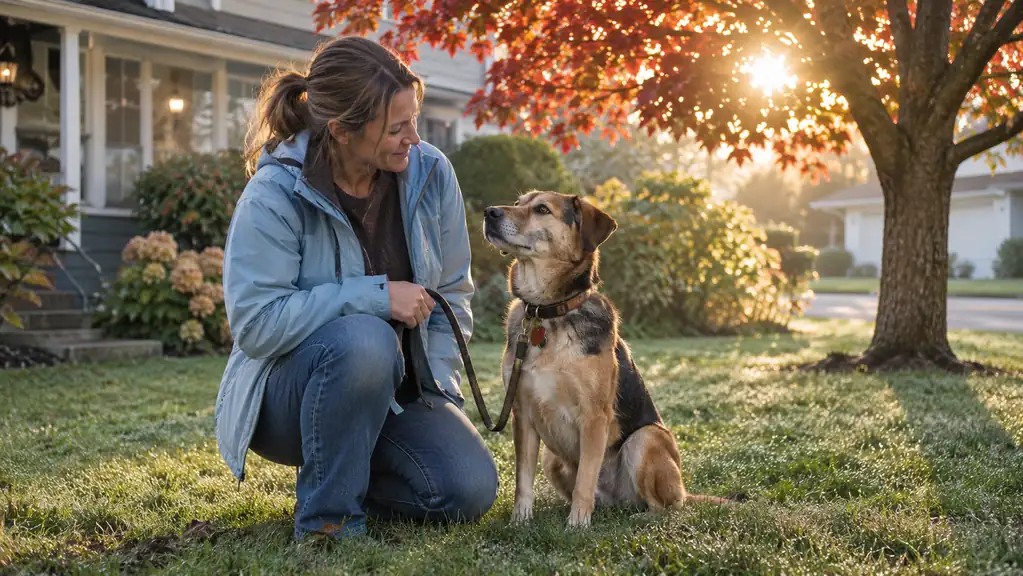
Three years ago I would have told you a treat pouch is just a bag. You put kibble in it, you hang it off your belt, you get on with your walk. That was before Biscuit. He came home from the county shelter at age two, sixty-five pounds of Labrador mix with no leash manners and a strong interest in every squirrel in Pettis County, and my training went from an occasional weekend thing to four or five short sessions a day. When you are reaching for a piece of food that often, a jacket pocket stops being good enough. I bought the LANNEY Dog Treat Pouch in the fall and have worn it almost daily since, on neighborhood walks and at the city park on weekends. This is the version of the review I wish somebody had handed me before I spent the money.
The short version, before I get into the details. It is a sturdy bag that does the main job well, and there are three or four things about it that the listing photos never show you. Two of them are genuinely good. The rest are the kind of small friction you only find out about after a week of use. Whether that trade is worth it depends far more on how you train than on how the bag is built, so let me start there.
The Quick Verdict
A roomy, well-built training pouch whose drawstring top genuinely opens one-handed, which is the whole point of a treat bag. The waist belt is basic, the close takes two hands, and it rides heavy on the hip. For daily reward-based training at home, it earns its place.
Amazon Check Today's Price →The drawstring opens with two fingers. That two-second gap is where training actually happens.
Roomy enough for a full session, with an adjustable waist belt, a shoulder strap and a clicker in the box. 4.7 stars across more than 5,000 reviews. Check today's price and the current listing on Amazon.
Amazon Check Today's Price on Amazon →What the Listing Photos Do Not Show You
Every treat pouch listing in the world uses the same three photographs. A smiling person. A dog in a neat sit. A hand reaching into an open bag. What those photos cannot show you is the only part that decides whether you keep using the thing, which is what happens in the two seconds between your dog doing the right thing and the food arriving. That gap is where training lives. Fumble the bag and you have taught your dog that sits are followed by a pause and a zipper sound.
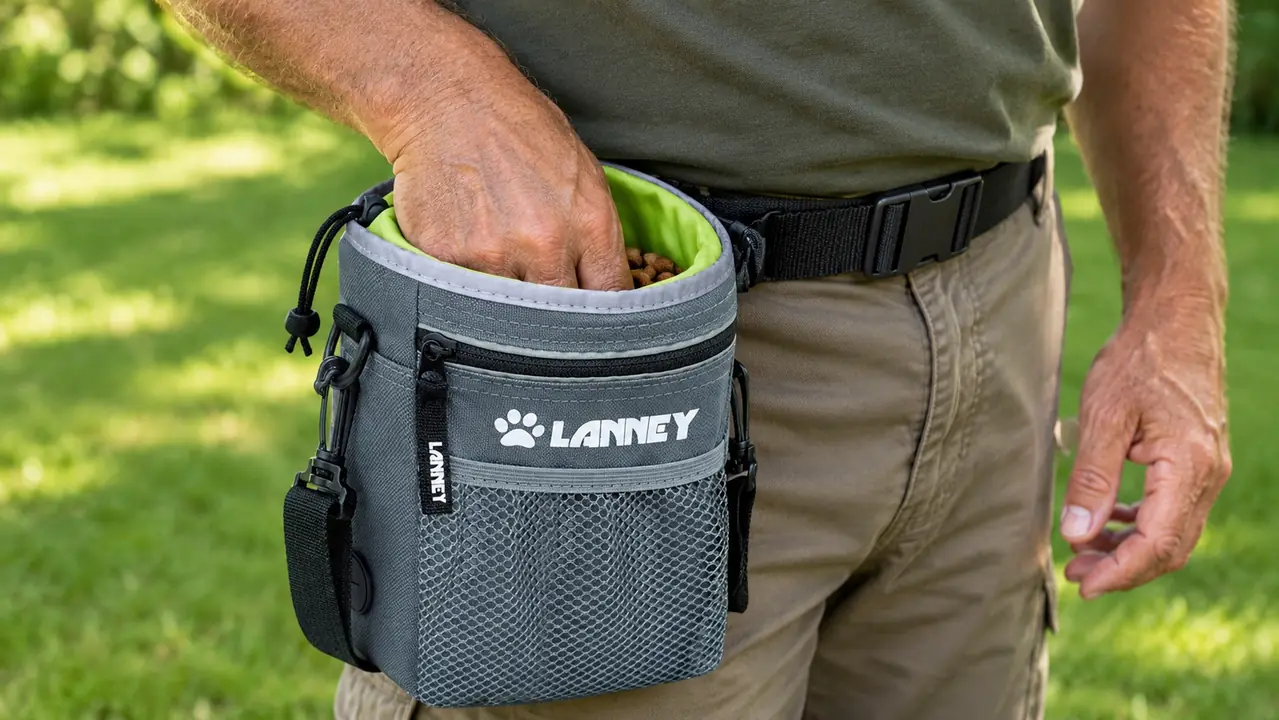
The LANNEY pouch handles that gap with a drawstring and a cord lock, and it is the single best thing about the bag. You press the lock, pull, and the mouth opens wide enough to get a hand all the way in without looking down. I can do it with two fingers while the leash is in my other hand and Biscuit is mid-pull. Nobody puts that in the product photos because it is not photogenic. It is also the entire reason the bag works.
The second thing the photos hide is size. This is not a little belt purse. It measures seven and a half inches across, seven and a half tall and about an inch deep, and it weighs a bit over eight ounces empty. That is real capacity, enough that I stopped carrying a backup bag of treats in the truck. It is also a real object hanging off your hip, and I noticed it for the first week before I stopped noticing it at all.
How I Have Used It With Biscuit
Biscuit and I do short sessions, three or four a day, five to ten minutes each. Mornings are loose-leash work in the front yard. Midday is name response and a little impulse control in the kitchen while June is making lunch, which is the hardest distraction in the house and possibly the county. Evenings are the neighborhood loop, and on weekends we drive over to the city park for recall practice on a long line.
The LANNEY pouch carries a full session without trouble. Two good handfuls of kibble plus a few higher-value bits for the hard repetitions, and there is still room to get my hand to the bottom of the bag. That matters more than it sounds. A pouch that only holds a quarter cup means you are refilling mid-session, and refilling mid-session is a break in the lesson, which is exactly what you do not want with a dog who is just starting to understand what you are asking.
The first week I made a mistake worth passing on. I loaded the pouch with Biscuit's regular kibble and nothing else, the same kibble that sits in his bowl all day, and his attention wandered off somewhere around the third repetition. A trainer at the group class had told me this and I had nodded politely and ignored it. Once I started mixing in small bits of boiled chicken and a few broken-up training treats, keeping the boring kibble at the bottom and the good stuff near the top where my hand lands first, the sessions got noticeably sharper. The bag did not change. What was in it did. Worth knowing before you decide the pouch is not working.
One thing I stopped doing after a couple of weeks: wearing it on the shoulder strap around the house. It swings when I bend over to deliver a reward, and Biscuit is a nose-first dog who will investigate a swinging bag with his whole face. On the waist it stays put. The shoulder strap is fine for a straight walk where you are not bending down every thirty seconds, and it is genuinely useful at the park.
The Three Ways to Wear It, and Which One I Use
The listing says three ways to wear and ships an adjustable waist belt and an adjustable shoulder strap. In practice that means on your waist, over one shoulder, or across your body with the strap shortened up so the bag sits at your side. I have used all three and I would not call any of them a gimmick.
The waist belt is what I use daily. It is plain nylon webbing with a plastic side-release buckle, adjustable across a wide range, and it holds the pouch steady at the hip. It is not padded and it is not fancy. Over a jacket in cold weather it is perfectly comfortable. Against a shirt in a Missouri July you will know you are wearing a webbing belt, and that is the honest trade.
The shoulder strap I save for the park, worn across the body so the bag sits at my side instead of bouncing. June uses the shoulder strap when she takes Biscuit out, because she does not like anything around her waist. Two people, two preferences, one bag. I did not expect that from an accessory and it has saved us buying a second one. It is the sort of thing that makes the LANNEY pouch easy to recommend to a couple who both walk the dog.
The Pockets, and What Actually Fits
There is one enlarged zippered pocket on the front, one zippered pouch on the back for small items, and two waste bag dispensers, one on each side. The front pocket takes my phone, which is a plain mid-size Android in a rubber case, with room left over for a folded bag or two. I measured the whole pouch at seven and a half by seven and a half by one inch with a tape from the kitchen drawer, and that front pocket is a good deal smaller than the bag, so measure your phone if that is the deciding factor for you.
The back pocket is where the small things live. Two or three folded waste bags, a couple of treats I want kept separate from the main load so they stay interesting, my keys when I am not carrying much else. It is not big. It is a pouch, not a wallet, and it does not pretend otherwise.
The two side waste bag dispensers are the quiet win of the whole design. I used to carry a loose roll in my jacket and find it in the laundry. Now there is one on each side, which means when one runs dry I am not walking home with a full bag in my hand and nothing to put the next one in. Small thing. You notice it about a week in and then you cannot go back.
The Clicker in the Box
The pouch ships with a clicker, and the listing describes it as having a loud noise, which is accurate to the point of understatement. The first time I clicked it in the kitchen, Biscuit startled and June asked what had broken. If you have a sound-sensitive dog, muffle it in a pocket for the first few sessions or skip it and use a marker word like yes instead. That is not a knock on the clicker. It is a knock on assuming every dog will take a sharp noise in stride.
I already had a clicker from the group obedience class we took at the pet store, so the one in the box became a spare that lives in the truck. That is not a complaint. A spare clicker is a useful thing to have, and I like that the LANNEY pouch did not assume I already owned one.

How It Has Held Up
The outer material is 600D oxford cloth with a PVC coating, which in plain English means it is a tough woven fabric with a wipeable backing. After months of daily use, including a fair number of rainy walks and one memorable incident involving a peanut butter treat that melted, it has not torn, frayed or separated at the seams. I wipe it out with a damp cloth every couple of weeks and let it dry open on the porch rail.
The one thing I have learned about keeping it decent is that a drawstring pouch wants to be emptied. I left half a handful of chicken in the bottom overnight in October, and by morning the whole bag smelled like a bait shop. A rinse and an afternoon in the sun fixed it. Now I dump the leftovers into the kitchen trash when we come in, which takes four seconds and saves me from that smell again.
The zippers have stayed smooth and the buckle has not popped open on its own, which is more than I can say for a cheap belt I owned years ago. The cord lock still grips. If there is a weak point in the long run I suspect it will be the webbing belt where it feeds through the buckle, because that is where every belt eventually gives out, but so far it shows no wear at all.
The Things That Bug Me
The drawstring closes with a pull, and that pull takes two hands when the bag is full. Opening is one-handed. Closing is not. When I am mid-session with a leash in one hand and a clicker in the other, the pouch tends to stay open for the duration, and an open pouch with a nose-first Labrador standing nearby is a known risk. I have watched Biscuit help himself exactly once. That was enough for both of us.
It rides heavy. Eight ounces empty plus a session's worth of food on a webbing belt is noticeable on a long walk, especially in the first week. If you are used to carrying treats loose in a jacket pocket, this is a bigger commitment on your hip than you are picturing right now.
The belt itself is the least interesting part of the package. Plain webbing, plastic buckle, no padding. It does the job and it is not the thing you will write home about. I would have paid a little more for a padded version if one existed, and as far as I can tell it does not.
And here is the honest one, the thing I would say to anybody over the fence. A treat pouch does not train your dog. It removes one excuse. If you are not doing short, frequent sessions with food your dog actually wants, this bag is a place where kibble goes to get stale. Biscuit is not fixed. He is better, most days, and the pouch helped me be more consistent, which is the only thing that helped at all.
What I Liked
- Drawstring with a cord lock opens wide one-handed, so the reward lands within a second or two
- Holds a full training session with room to reach the bottom of the bag
- Adjustable waist belt and adjustable shoulder strap both included, so two people can share one pouch
- Front zippered pocket takes a mid-size phone, back pocket takes keys and bags
- Waste bag dispensers on both sides, which I did not know I wanted until I had them
- 600D oxford cloth with a PVC coating wipes clean and has not torn in months of daily use
Where It Falls Short
- Closing the drawstring takes two hands when the bag is full
- Bulky at 7.5 by 7.5 by 1 inches and a bit over 8 ounces empty
- Waist belt is plain webbing with a plastic buckle and no padding
- The included clicker is loud and can startle a sound-sensitive dog
- An open pouch plus a food-motivated dog is a supervision job, not a storage solution
Press the cord lock, pull, and the mouth opens wide enough to get a hand in without looking. That is the whole reason this bag earns a spot on my belt.
Who This Is For
This pouch is for the everyday owner doing reward-based training at home, the person who read a book or took one group class and is now practicing sits, downs and loose-leash walking in the yard and on the sidewalk. It suits you if you want treats on your body rather than in your hand, if you train several short sessions a day, and if you like the idea of one bag that works on your waist for yard work and across your body for a park walk. It is also a good fit for older owners who do not want to bend down and dig in a coat pocket every thirty seconds, which is a real consideration and one I now understand personally.
Who Should Skip It
Skip it if you train with a toy instead of food, because a food pouch with a wide open mouth is dead weight in that case. Skip it if you want something that disappears into a pocket, because this will not. Skip it if your dog is sound-sensitive and you know you will never use a clicker, since part of what you are paying for is a clicker you will leave in a drawer. And skip it if you need a sealed container, because a drawstring pouch is not airtight and a strong-smelling treat will scent whatever it hangs against. For everyone else, the LANNEY pouch is a well-made bag with one genuinely excellent design decision and a few small annoyances that you will adapt to inside a week.
If your dog will work for food, the bag should not be the reason the reward is late.
Adjustable waist belt and shoulder strap, a front pocket that fits a phone, waste bag dispensers on both sides and a clicker in the box. Check today's price and the current listing on Amazon.
Amazon See the LANNEY Treat Pouch on Amazon →